Thursday, August 09, 2012

Jazz Festivals From The Journalists' Side

Next to receiving free CDs, covering a jazz festival is likely the ideal thing that people think of when/if they consider how great it would be to work as a jazz journalist. The reality—like the reality of dealing with thousands of uninvited pieces of plastic—is somewhat different.

Like every other jazz-loving kid, I enviously read dispatches from Montreux and Newport, and dreamed of being 'on assignment'. But my first actual experience with jazz festival journalism was practically begging reporters to come out to cover the festival I helped manage in my hometown of Ottawa. During the festival's first decade—in the 1980s—no journalists were beating down our doors, scrambling for media credentials.

In 1991, the tables had turned, and I talked the arts editor of The Ottawa Citizen into letting me cover the same festival (whose employ I had left in 1989) the way I thought a festival should be covered. By the end of that year's 10-day festival, having cranked out thousands of words on very tight deadlines, I was begging to be put out of my misery. How many more versions of "Round Midnight" could I parse for meaning?

It turns out that reporting on a festival is even more work than managing one. Few reporters have the stamina of my friend John Kelman, the seemingly indefatigable AllAboutJazz.com editor who has become a one-man festival wrecking crew. Approaching an extended festival, which usually has multiple strands of musical genres and performance venues on display, takes strategy. That keeps your critical faculties fresh, but it also helps ensure that readers/listeners aren't overwhelmed by a torrent of words about dozens of acts. A good festival dispatch requires shape and sound structure.

On Wednesday, August 15, at 8 p.m. Eastern, several of us will be discussing the art of jazz festival reporting in the second of an ongoing series of webinars organized by the Jazz Journalists Association. Attendance is free, but registration is required. You can read more about the event, and register, here.

Tuesday, July 31, 2012

Revisiting Euro-Jarrett

Perhaps I was too enraptured by his so-called American Quartet or too much in love with his rapturous solo inventions of the 1970s, but I never delved too far into Keith Jarrett's 'European Quartet' with Jan Garbarek, Jon Christensen and Palle Danielsson. The band struck me as cold and rather academic in comparison to Dewey Redman's squawking raunch, Charlie Haden's deep grooves and Paul Motian's effortless swing.

So, if you've been lucky enough to hear Sleeper, the 1979 concert that ECM released last week, you know what a slap in the head I've taken. I've long since become a huge fan of Garbarek (many thanks to my late friend Eric Nisenson for hipping me to the saxophonist's great works) but his gruff, extended blowing here is still a revelation. On "Chant Of The Soil" and "New Dance," he takes Jarrett's music as out as Redman ever did, but with more connection to the melodic core of the compositions. In concert, the Latin grooves of "Personal Mountains" and "New Dance" have a slippery essence that I wasn't expecting.

What a joy it is to discover exciting music like this 33 years after the fact. I'll just try not to kick myself too often for missing it all this time.

Wednesday, July 11, 2012

A Death In The Family

When a standalone restaurant closes, it's usually a highly local story. But, when that restaurant doubles as the headquarters of a city's jazz scene, it's a death that affects us all in the music community.

Café Paradiso was one of those places; a singular jazz venue in a mid-sized Canadian city that has proven incapable over the past 40 years of sustaining more than one jazz club at a time—often with gaps of many years between their deaths. Its closure on June 30—less than two weeks after playing host to a Jazz Hero satellite party for the Jazz Journalists Association Jazz Awards, and immediately after a performance by vocalist Theo Bleckmann and guitarist Ben Monder—leaves a big hole in the club circuit that exists just north of the Canada/U.S. border, in Toronto, Kingston, Ottawa, Montreal and Quebec City. Its presence allowed artists like Bleckmann, Sheila Jordan and Dave Liebman to make economic sense of venturing north of New York City, hooking up single-night gigs in places like Montreal's Upstairs and Quebec City's Largo in addition to a night at Paradiso.

Recently, on Facebook, I sang the praises of club owners like Upstairs' Joel Giberovitch, Largo's Gino Ste-Marie and Paradiso's Alex Demianenko—impresarios who are in the business for their love of the music, rather than simply restaurateurs who think they can make a buck off hungry and thirsty jazz lovers.

Roddy Ellias at Café Paradiso in June
I barely knew Demianenko, but let me tell you what I learned about him in a short time. My jazz critic colleague Peter Hum introduced me to him one afternoon in April. I told Demianenko I wanted to talk to him about possibly holding the Jazz Hero event at his club. He asked me to step into the small passageway between his bar and kitchen, and I made a four- or five-minute pitch to him about the Jazz Journalists Association and the Jazz Hero concept. He'd never heard of the association or its annual Jazz Awards, but he listened intently, nodding his head, and said, "I'd love to do it. I'll pay the band."

Now, the most Hum and I had hoped was that a club owner might offer us the space and allow us to invite some local musicians up to jam, but here he was offering to pay for a band to play on what would normally be an off-night for his club.

Maybe that's the kind of risk-taking that led to Paradiso's closure, but it's also the kind of generosity that you see too little of in the world of jazz clubs.

As noted, Ottawa has seen them come and go over the years: The Penguin, Woody's, Take Five, After Eight. If you've been around town long enough, it can seem like a sad roll call of faded dreams.

But, here's one to dreamers like Alex Demianenko; they keep the jazz world turning.

Monday, July 09, 2012

A Band Is Born

There are few things as thrilling in music as when musicians whose work you love form a new group and the results define the cliché of the whole being greater than the sum of its parts.

The new Dave Douglas/Joe Lovano quintet—known as Sound Prints, in subtle homage to Wayne Shorter—is just such a thrill. With the sublime Joey Baron on drums, Linda Oh on bass and Lawrence Fields on piano, the band already sounds fabulous, and it's really just starting out. It's now in the midst of a European festival tour, before returning home to play Newport and Detroit in the late summer, and finally making it to the Village Vanguard in the fall. One can only hope that the Vanguard date will be recorded.

I caught the band's second official gig (a version of the group played in Boston with James Genus on bass late last year) on this summer tour, and my review of two sets is up today on the DownBeat website.

Wednesday, July 04, 2012

The Graying Of Jazz

The main stage structure in Ottawa's Confederation Park—home base for the TD Ottawa International Jazz Festival—has only just been dismantled, but the pundits are already debating what transpired there over the event's 10 days.

Ken Gray, a former editorial board member at the city's major daily and ongoing columnist, is a man who loves to lounge in the park and listen to music, and as he writes here he's willing to see the festival die a slow death rather than be subjected to music that he feels doesn't belong. My estimable colleague Peter Hum takes him on through the digital pages of the same newspaper.

Like many critics, Gray is only too happy to tell you what he doesn't like—anything that he feels smacks of pop, rock or blues—but is woefully short on opinions of just who might fill the bill to keep vacationing public servants and retirees nodding their heads and making trips to the beer concession as the festival sails toward the inevitable sunset of his doomsday scenario. He's also woefully blind to everything that goes on away from the festival's main stage (which, this year, included what was perhaps the best set of improvised music—performed by the new Dave Douglas/Joe Lovano quintet—I've witnessed in a couple of years anywhere) and how much those shows are subsidized by the 11,000 or so music fans who show up outdoors to hear the likes of Robert Plant or Steve Martin in all their non-jazz glory. In an earlier entry, I highlighted how much popular mainstream acts contribute to the coffers of the festival, which often loses money on jazz acts (the second set of that stellar Douglas/Lovano band attracted only about a one-third house, for example).

Of course, Gray also overlooks the reality of history. He falls back on that old saw that jazz never sounds better than it does on a summer's evening when it's played outdoors, presumably casting his mind back to the archetypal summer jazz fest at Newport, Rhode Island. Conveniently, he overlooks the fact that promoter George Wein—in addition to popularizing the concept of the outdoor jazz festival—also pioneered the inclusion of popular artists who drew from the same roots as Dizzy Gillespie and John Coltrane. Hence, Wein's inclusion of acts like Chuck Berry and, a decade or so later, the Allman Brothers Band, in the Newport Jazz Festival lineup.

No, Gray would rather see the festival shrink, or even perish—a vision that is not only ridiculously shortsighted, but diminishes the contributions of the artists who are performing in venues that promote close listening.

With 'fans' like that, is it any wonder that so many younger musicians reject the notion of jazz altogether?


July 8 Addendum: Here's an interesting perspective on the crux of this issue from pianist Robert Glasper, who believes jazz as the purists like Gray see it is a "secret club."

Wednesday, June 20, 2012

A Festival Blooms In Quebec City

On the eve of summer, and the attendant launch of jazz festival season across Canada and the United States, one of my favourite festivals—the Quebec City Jazz Festival—has just announced its 2012 lineup, and it's beauty for an event that is just a few years old.

The festival is focusing on the trumpet this year, so there's Arturo Sandoval, Paolo Fresu, Ingrid Jensen, Eric Truffaz, Joe Sullivan, Jeremy Pelt, Christian Scott and a tribute to Miles Davis, but that only hints at the depth of the programming and the distinctive vision that the festival brings to its booking.

In keeping with my belief in full disclosure, I must admit I played a small role in recommending the booking of pianist Ran Blake, who will bring his love of film noir to a special presentation of the music composed for Alfred Hitchcock's film I Confess, which was based in Quebec City.

Last fall, along with my DownBeat colleague John Murph, I spent several days enjoying the festival, and then reflecting on what makes the festival unique. Here's what I wrote:


Art and urban upheaval often intertwine, whether the setting is Berlin between the wars or New York City in the mid-‘70s. That artists are drawn to cities and neighborhoods where rents are cheap is no surprise, but the spark generated by these huddled innovators doesn’t always catch fire and change the entire face of a community.

In Quebec City, a city of 500,000 dominated by provincial government and tourism, a five-year-old jazz festival is the unlikely catalyst of a boom that has helped to transform the once-derelict district of Saint-Roch into the kind of burgeoning creative community that urban theorist Richard Florida sees as a key to sustainability.

Festival president Gino Ste-Marie
Festival president Gino Ste-Marie remembers Saint-Roch before it was on the radar of the New York Times’ travel writers. Hoping to draw tourists westward from Quebec City’s quaint 17th-century shopping area that has been recognized as a UNESCO World Heritage Site, in the ‘70s the city built a weatherproof enclosure over Saint-Joseph Street, which runs through the center of Saint-Roch. Unfortunately, the renewal project attracted far more prostitutes and drug dealers than tourists.

“It was a beautiful street in the ‘50s,” said Ste-Marie. “But they hid the architecture and made it a scary place. It was a desert. It broke my heart to see it like that.”

The city decided to remove the enclosure in 1998, but the damage had been done.

Ste-Marie pined for a time when Quebeckers believed that Saint-Joseph, with its dominant cathedral and broad sidewalks, could hold its own with ‘The Main’—Montreal’s storied Saint-Laurent Street. Early in the new millennium, he opened a jazz club and restaurant called Largo on Saint-Joseph, staking his future on the street’s recovery.

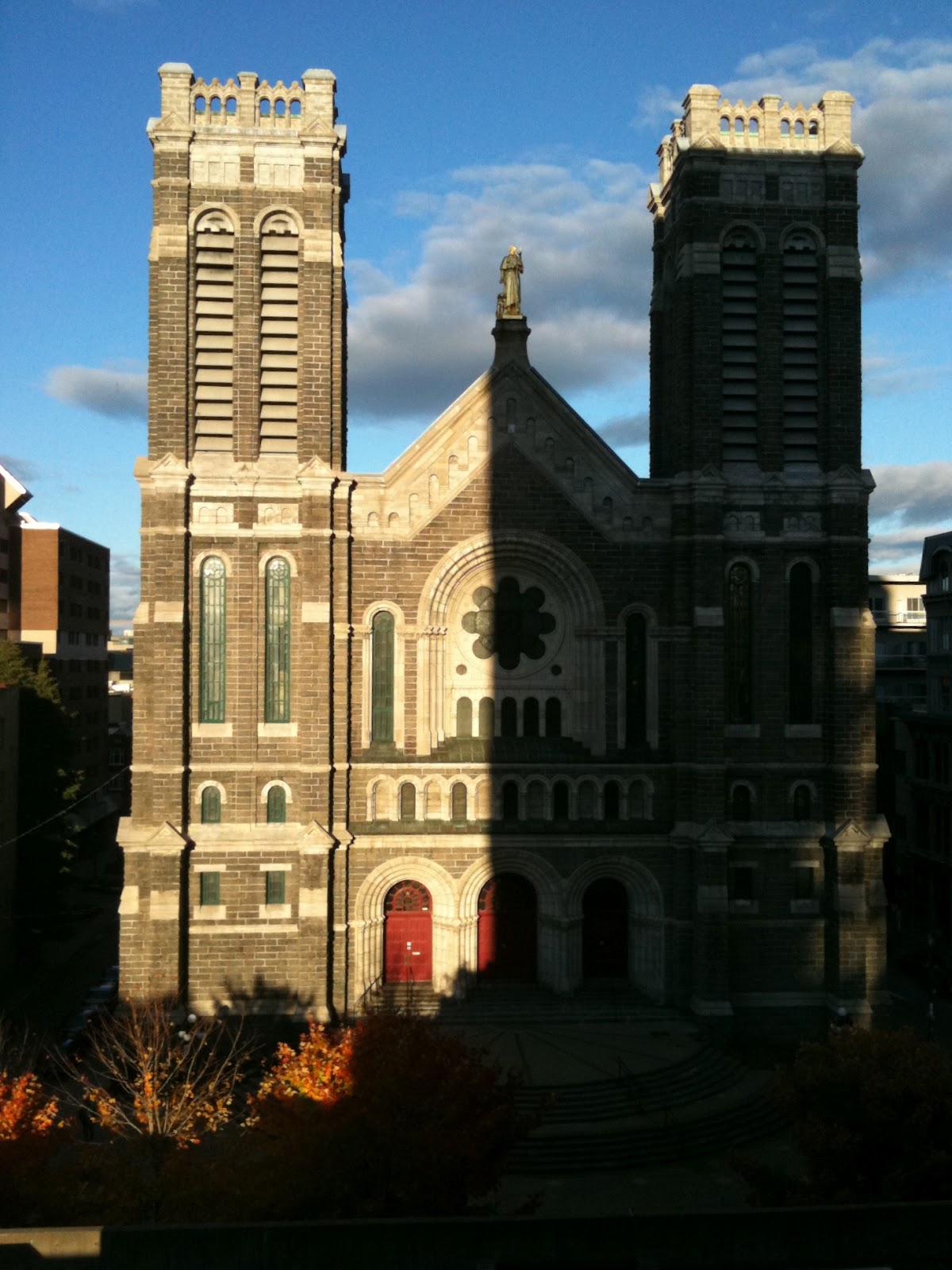
The Saint-Roch cathedral
“It was a freaking operation,” he said, “a big dice throw.”

Embracing the street, even while it was still stumbling back to its feet, he hung local art on the walls, encouraged restaurant patrons to hang around the neighborhood, and championed local musicians like bassist Guillaume Bouchard—a burly, bearded Mingus acolyte who had given up on music to drive a truck.

While Quebec City has a history of supporting artists who help keep shiploads of tourists happy (Cirque du Soleil grew out of a troupe of government-funded buskers who worked the broad plaza adjacent to the iconic Chateau Frontenac hotel) the city lacked a strong year-round music scene to serve residents. Jazz was almost non-existent through the ‘80s and ‘90s, despite the large number of artists just 300 miles away in Montreal. Some talented Quebec natives a generation older than Bouchard, like the extraordinary drummer Pierre Tanguay, had moved to Montreal, giving up on the idea of ever making a living in their hometown.

In 2006, Ste-Marie established a foundation to promote culture in Quebec City, raising funds through the sale of locally sourced bottled water, and launched his annual jazz festival.

“Jazz was dead here for 20 years,” he said. “And yet, Quebec has so many great artists. Beginning with Largo eight years ago, my mission has been to start with Quebec jazz, not just produce international names. The odd thing about Quebec is that it’s easier to produce a concert by (Montreal-based pianists) Lorraine Desmarais or Oliver Jones than an artist who is known around the world. So, my strategy is to start with a week of Quebec artists, then mix in internationally known names.

Just five years in, Ste-Marie and his youthful teammates Simon Couillard and Nicolas Marcil seem to be doing everything right.

By blanketing the city with creative music—and shining a bright light on Saint-Roch’s renaissance—they have accomplished something that other, more-seasoned festival producers view as a critical key to building a viable local base of artists.

The Palais Montcalm is one of the festival's venues
“Good music begets more good music,” said Bill Royston, who recently retired after eight years as the head of the Portland Jazz Festival. Having previously organized successful festivals in Pennsylvania (including the Clifford Brown, Berks and Penn’s Landing jazz festivals) he said: “Partnerships both within and outside the community are very important for the survival of a jazz festival and related events. Externally, cultural tourism efforts represent some of the most pivotal efforts to reach new audiences.”

“It’s really important to galvanize a community in support of what you’re doing, with an eye toward creating a living neighborhood,” said Ken Pickering, a co-founder of the Vancouver Jazz Festival, who serves as the event’s artistic director. “Festivals like ours have been instrumental in bringing culture to neighborhoods.”

Northwest of Toronto, in the small, university-dominated city of Guelph, jazz festival director Ajay Heble has applied both the theory and the practice of community building through art. Since 1994, his annual post-Labor Day event has produced shows by artists including Han Bennink, Muhal Richard Abrams, Pauline Oliveros, Henry Threadgill and Steve Coleman, at the same time as it has brought academics together to discuss the relation between improvised music and community.

“Improvisation is a powerful voice,” said Heble. “It’s a powerful model for how we get along as societies, and how we build sustainable communities. Music has a social role, and what we’ve done here is build a strong local audience for what might be perceived as challenging music.”

“I’ve always believed that a successful jazz festival has three responsibilities,” said Royston. “Present international artists who otherwise might not be seen in your area, provide a viable series of showcases for local artists, and offer free jazz education events that extend into the neighborhood within the overall community.”

Pickering added that those types of approaches will help see a festival through tough economic times. “We’ve lost 40 of our regular programming slots,” he said. “When that happens, you have to focus on essentials, be proactive and find new partners.”

For Ste-Marie, the key to continued success is following those principles. He has worked hard to position jazz as one of the art forms supported by Quebec City’s activist mayor, Régis Labeaume—who has poured $50 million into developing artists’ ateliers—and struck alliances with major hotels to draw people to the city in the shoulder season before winter. And, if harder times come, he’s convinced he has firm bedrock beneath him.

“It all comes back to our culture—Quebec culture. I’m radical about that. I’m pretty proud that we keep that front and center, no matter what. This city, this neighborhood, it’s my heart.”


Monday, June 18, 2012

The Heat Is On

In the dead of winter, especially in the dead of a winter in Eastern Ontario, it can seem like a long time between jazz festivals. But, now, with the temperature in the high 20s (Celsius) and rising, comes the most-anticipated week in the whole year.

This year, I'm starting my jazz festival celebration early by emceeing an event to honour the man who booked the Ottawa International Jazz Festival for many years: Jacques Emond. Tonight, Jacques will be receiving the Jazz Journalists Association JAZZ HERO award in conjunction with this year's Jazz Awards, which will be held in New York City later this week. As a concert promoter and radio host, Jacques has been a tireless champion of jazz for decades; the kind of local hero who exists in communities throughout North America. The JJA—and hopefully a few dozen friends here in Ottawa—are delighted to give him a little recognition, and encourage others to give a word of thanks to all those other heroes out there who keep jazz alive at the community level.

On Thursday, a double bill of blues journeymen John Mayall and Robert Cray kicks off this year's edition of the Ottawa jazz fest, which promises a number of highlights.

I'm particularly looking forward to the new quintet co-led by Dave Douglas and Joe Lovano, which I'll be reviewing for DownBeat's digital service. Inspired by their time working together in the SF JAZZ Collective, the band has its debut in Kingston next week before coming to Ottawa. It then hits the European festival circuit prior to its U.S. debut at the Newport Jazz Festival.

As excited as I am about catching early shows by this new group, it means I'll be missing what might just be the overall highlight for many people at this year's event: an all-star group led by the great New Orleans songwriter Allen Toussaint, featuring Christian Scott, Don Byron and Marc Ribot. I'm predicting that this is the show people will be buzzing about after the festival.

I know I've said this before about the Ottawa festival, but this is a particularly great year for catching some of jazz's best drummers. A short list: Eric Harland, Joey Baron, Brian Blade, Tom Rainey and Jack DeJohnette.

There's no shortage of great guitarists, either: Kevin Eubanks, Marc Ribot, Bill Frisell and Pete McCann.


Friday, May 04, 2012

A Brother's Tale

I met Gregg Allman in 1978 on a steamy day in Macon, Georgia, at an event that he mentions briefly in his new autobiography, My Cross To Bear. The day marked the first time The Allman Brothers Band had played together since its acrimonious breakup two years earlier (all the surviving original members had played together with guitarist Dickey Betts' band a week earlier in New York City's Central Park).

I had been a fan of the band since I heard their debut album in 1970, so I knew their story well. But, by the time I encountered him that summer, Allman had become a cipher—unsmiling, and hidden behind opaque shades and a curtain of long blond hair. He mumbled something I didn't catch when we were introduced, then turned his silence back on the people he had been standing with.

He'd been pilloried and ridiculed in the nascent People magazine during his marriage to Cher, and even made fun of in the comic strip Doonesbury. Since the death of his brother Duane in 1971, he'd become better known for his drug and alcohol abuse than his music, but even before his brother died Gregg had been so withdrawn and single-minded about what he did onstage that he seemed like some sort of savant. In interviews, he came off as cagey and a bit naive. Surely, there was more to him than that, but by the late '70s it was an open question.

I greeted the news that he was publishing a set of memoirs with interest... and trepidation. Even if you allowed that his memory might not be clouded by his years of substance abuse—and Keith Richards' autobiography proved that anything is possible—there was the fear that the book might either be bitter retribution for the years when he was the early butt of the celebrity media or a shallow remembrance of the band's triumphs.

What a joy it is, then, to read—or, in my case, listen to—a beautifully told, insightful and uplifting story of a man's life. For one thing, he is as funny as hell. Even the story of finding one of his wives having sex with an acquaintance is told with wry humour. As it turns out, his apparent caginess is actually shyness, and what passes for naivety is really the sign of a sensitive soul who refuses to dwell on negative feelings about six ex-wives or people, like former manager Phil Walden, who did him wrong. While he writes compellingly about the bond between the original members of the ABB, he's brutally honest about how those bonds have been stressed over the past four decades, and isn't one to peddle trite phrases about brotherhood. Gregg Allman has always been about music first and foremost, and when people don't act in the best interest of making music, he says so. If he was exhibiting reticence at the time I met him it was because he still wasn't sure if the others in the band were willing to recommit without reservation to finding the magic they'd once had onstage, and set aside the trappings of rock stardom that had derailed them in 1976, at the height of their fame.

In that regard, he reflects a statement his brother once made: "This ain't no fashion show. In this band, you better come to play."

Duane's sentiment was borne from hard years on the road, when the teenaged Allmans struggled to create their own music, and then to get a chance to perform it. In the mid-'60s, the star-making machinery of the Hollywood pop music scene had almost waylaid both their musical careers and their sibling friendship, and Gregg shows his early strength when he sacrifices his own ambitions, returning to Los Angeles as a solo artist in 1968 so Duane could remain in his beloved South. Duane's side of the story has only been told second hand, but apparently he reacted with anger, thinking his brother was selling out.

The relationship of the two—born little more than a year apart—was complex; Duane was a reckless, charismatic leader, who always knew just how to push his little brother's buttons. But Duane was also a brilliant, driven musician—a distinctive virtuoso at the age of 22—who had a clear vision for what it took to create an exciting hybrid of rock, blues and improvised music. He drove everyone around him mercilessly, and most of all Gregg.

He drives him still, haunting Gregg with the memory of their last conversation on the morning of October 29, 1971, when a cocaine deal led Gregg into a lie. That afternoon, Duane was pinned beneath his Harley Davidson on a Macon street. He died of massive internal injuries. Gregg writes: "The last thing I ever said to my brother was a fucking lie, man.... I have thought about that every single day of my life since then. I told him that lie, and he told me that he was sorry and that he loved me. I was so dumbfounded, I couldn't say nothing back to him."

In that moment, and numerous others in My Cross To Bear, your heart breaks for this man, and you clearly see the kind of weight that he has carried, dragging him often into chemical means of escape. This is a fearless, unself-pitying picture of a man.

It's a story you have to live through a lot to tell, but that alone won't give you the tools to tell it. To do that you need to be able to reach the part of yourself where it's a relief to share something like you've been hurt so bad that you feel like you've been tied to a whipping post.


Friday, April 20, 2012

Levon's Grace Notes

So much has been written and said about Levon Helm in the days since his health took its final turn that there's not much to add. But a couple of things have been on my mind.

First, as an occasional drummer, it's impossible to comprehend playing soulful music without dealing with the way he manipulated time: just playing alongside musicians as idiosyncratic as Garth Hudson, Rick Danko, Richard Manuel, Robbie Robertson and Bob Dylan—alternately pushing and pulling them—and keeping it all as tight (and loose) as it sounded! Often overlooked when people talk about the great percussionists of the 1960s and '70s, he was a master. As I write this, I notice that the great Jack DeJohnette has paid his props to his Upstate New York neighbour.

Second, I cherish the times I got to listen to him close up, when he hit the road with Earl and Ernie Cate after The Band fell apart. At Ottawa's legendary Barrymore's, I saw a number of musicians who had once played to audiences hundreds of times larger: Gregg Allman, Sly Stone, David Johansen, Burton Cummings. No one ever handled that shift from mass appeal to playing a Sunday matinee or Tuesday night gig at a small club in Ottawa with more grace than Levon. Watching him on nights like that made you realize that this was a man who never viewed playing music as a job. It was a joy, and that fact was all over his face, and all through his music. In those days, he always struck me as a small-town baseball player who had taken his shot at the big leagues, had a few seasons at the top and now was back on the bus, just happy to be able to play a game for a living.

Wednesday, March 07, 2012

Professing Professionalism


Michelle Mercer and me at AWP
I'm just back from an extended trip to Chicago, which included a speaking engagement at the annual conference of the Association of Writers and Writing Programs. On a panel that included Emilie Pons, Michelle Mercer, Howard Mandel and Alan Stanbridge, I addressed the need for professional standards in music criticism and journalism.

Thanks to Michael Jackson, Chris Tarry, Neil Tesser and everyone else who came out to fill the room and ask interesting questions.

Here's a copy of my presentation:


First, some context for my comments

They don't come from any bias against technology as it applies to our art form: I wrote my first online article in 1992. I was an early blogger, and eagerly spread my work in digital form as soon as there were people with the tools to receive it.

Neither do I have an age bias, even though I've been in the business now for 35 years. Through the Jazz Journalists Association, I have mentored a number of young music writers, and I happily consume and encourage the work of younger compatriots.


Michelle Mercer, me, Emilie Pons, Howard Mandel

My point of departure is Orrin Keepnews' curmudgeonly 1987 essay, "A Bad Idea, Poorly Executed…" in which he decried uninformed, overly opinionated and badly written jazz criticism.

In the main, Keepnews argues for professionalism and style.

I share his viewpoint, and I've modeled my career—in large part, unknowingly—on his design. I urge you to read his essay, as it has its own argumentative muscle and examples (mostly based on his years as a producer for people like Sonny Rollins and Thelonious Monk, and on his time as a label executive). 

But here are my own tenets for good music criticism: If you're going to write about the music, it's not enough to enjoy the music, even if you can summon the linguistic energy to communicate your passion to others. Sadly, that is still what gets some people their jobs in music writing. 

There was a time when it was commonplace in some types of arts coverage—where the art was considered mainstream, or lowbrow—where coverage was assigned to anyone who expressed an interest in it. For example, the longtime film critic at the newspaper where I worked for a decade got the job because he liked going to the movies. The growth and rapid evolution of film schools in the '70s and '80s—and the calibre of knowledgeable young film aficionados they turned out—killed that notion for film. 

Unfortunately, it's still the case that jazz assignments—to say nothing of pop music assignments—go to writers who have an interest… and often, it's an interest that doesn't extend far beyond receiving review copies and complimentary concert tickets.

The most egregious recent example involved someone I actually know. He's a fine newspaper writer, but knows nothing about jazz. And, as it turned out, he has some odd ideas about femininity, too. Assigned to review a concert in Montreal by the Maria Schneider Jazz Orchestra, he spent an inordinate amount of space pondering the significance of Ms. Schneider's bare arms. Needless to say, the artist, a large number of her followers and a large segment of the music journalism sector was outraged that this happened in a blog posting associated with a major daily newspaper. 

Back to my tenets. 

Before you write about music, here is an incomplete list of the things you should do: 

Spend time observing musicians recording. You're going to be writing about recordings; you better know how that works. Believe me, in most cases, it's not what you think.

Listen to musicians talking about music. Again, what goes on during the creation of this spontaneous art form is not necessarily what you think.

If possible, spend some time on the road with musicians. Drummer Matt Wilson loves to quote a music truism: They don't pay you to play. They pay you to get there.

Observe musicians onstage from a vantage point other than the audience. Even after all these years, this is still an education for me. I watched Al Green from the wings a couple of years ago, and the interaction between him and his bandleader, and the bandleader and the other musicians told a story the audience didn't get to share in.

After you've done all that, then you listen. And you listen some more.

Then you analyze what you've heard. You think about it in the context of all those things you've observed.

And you put the music in an historical context—both long range and short range.

And… then… you write.

When I recite those tenets, a lot of listeners are surprised that the writing holds such low priority. Isn't it all about the writing? The table stakes in our business should be the ability to write stylishly… to be able to employ metaphor and rhythm and tone.

My colleague Howard Mandel taught me that it's as important to have your language soar and stomp and whisper as effectively as the musicians do in the music you're addressing. 

Some of you may think I'm missing something from my tenets… What about playing music? Do you need to play music to write about it?

Personally, I cannot imagine not playing music. Why would you want to write about something professionally if you weren't interested in it enough to do it yourself? That's not to say you have to do it professionally to write about it, but it does help to understand the language and the way people work together in an ensemble to blend their voices and imaginations. 

So, with all that in mind, where are we going wrong? What are the dangers out there in music writing today? As I've mentioned, the "reviewer" problem is not new. Keepnews railed against it 25 years ago. 

The problem is exacerbated … and proliferated … by technology.
Time was that a dull-eared reviewer with leaden prose was a voice in the wilderness. Those who were cheerleaders for one artist or another sometimes were quoted in press materials, but otherwise their work seldom was seen beyond their immediate region. Now, they show up in Twitter feeds and through Facebook links. Publicists spread them around like a virus. 

Under the guise of "citizen journalism"—a term that covers a multitude of sins—anyone with an MP3 player and an opinion can now get equal footing with professional music journalists. If that were the only issue, there wouldn't be a lot of cause for concern, but the shift toward digital technology has combined with the harsh economic climate to shutter a number of print publications—from local arts papers to international magazines. Even those that survive are adopting new ways of competing… few of which promote exceptional music writing.

Perhaps the most egregious is SPIN magazine's decision to replace its short album reviews with review tweets. That's right, 140 characters to inform consumers about up to 75 minutes of music that an artist might've spent a year creating. 

Now, a well-crafted short review can be a thing of beauty. The great Robert Christgau turned it into an art form of its own in the pages of The Village Voice

A tweet review? Can it ever be more than a witty bon mot or a catty snarl? Invariably, it plays to the worst instincts of the bad reviewer, making everything sound as reductive as Mr. Blackwell's Worst-Dressed List. 

On a practical note, this movement is dangerous, too, because while it diminishes the importance of the art it also squeezes underpaid freelance writers even more. Will writers be paid as much to learn, listen and analyze if the result is a mere 140 characters? 

More likely, the professionals will be pushed away from the traditional sources of revenue. It's already starting to happen. The result is that some of these people will find other things to write about. Most curious people don't limit themselves to one interest. 

For the rest of us, it's imperative that we get as creative as musicians have had to become since the birth of digital media and find new avenues—and, yes, revenue streams—new ways of connecting with audiences who want to go beyond sales pitches or 140 characters. 

Perhaps—at least it's my hope—the additional effort will winnow the field, and the committed professionals among us will prevail. As someone who grew up loving the prose and the passion of music writers like Ralph J. Gleason, Greil Marcus and Robert Palmer … and buying the music they turned me on to … I can only hope that's the case.


Friday, February 17, 2012

Chris Tarry: Pursuing the Printed Word

If you're interested in speculative fiction in addition to music, check out my new piece on Canadian bassist Chris Tarry, who has been honing his skills as a writer of short fiction.

Before moving to Brooklyn nine years ago, Tarry was a stalwart on Vancouver's music scene, and a co-leader of the fusion co-operative Metalwood.

Rest Of The Story, his unique combination of short fiction and the latest CD by his quintet—featuring the great Pete McCann on guitar—is nominated for two Juno Awards.

Monday, February 13, 2012

Do We Really Want to Play That Tune?

My friend Peter Hum has a blog post decrying the absence of jazz musicians on the televised portion of the Grammy Awards, but really, do we want it to change? I think it's one of those cases where you need to watch what you wish for.

When even music business heavyweights like Bruce Springsteen get pushed into beefing up their regular stage presentations—to say nothing of other performers who are forced into bizarre musical mashups—is there any hope that the same wouldn't happen to Esperanza Spalding or Wynton Marsalis if they were invited to join the televised show? The fact is that since producer Ken Ehrlich began to introduce overblown extravagance and fever-dream duets to the show, the ratings have spiked. Last year's show drew 26.5 million viewers. All those tweets about Chris Brown and Nicki Minaj—even from those who are outraged—only serve to further the Grammy vision of spreading the word.

This year, I skipped the telecast altogether and happily watched the jazz awards being handed out in the live streaming pre-telecast feed. There was no excess, no music cues to cut off the acceptance speeches, and no one insisting that Terri Lyne Carrington had to trade fives with the guitarist from Dierks Bentley.

Saturday, February 04, 2012

New Venue for Jazz News

As it continues to revamp its music offerings on its traditional FM frequencies and on SiriusXM satellite radio, the Canadian Broadcasting Corporation is expanding its coverage of music issues online.

I have some skin in the game, as I'm pleased to have been invited to contribute to the new source of information.

Check out my first piece here, and find out more about the three-year/two-CD deal that Ottawa-based singer Kellylee Evans has just signed with Universal Music. It's quite a coup for the vocalist, who has quietly been building an impressive career.

Wednesday, January 18, 2012

What's Your Favourite Debut?

Fellow jazz critic Larry Appelbaum posted a Facebook link to John McLaughlin's album Extrapolations today, which caused me to post that I thought it was the best debut album by a jazz artist.

"A bold statement," he replied.

Is it?

Here's how I described how it sounded in my entry on McLaughlin in The Billboard Illustrated Encyclopedia of Jazz & Blues: "Already in place (at age 26) were the remarkably fluid technical facility, diamond-hard tone and harmonic imagination that would set him apart from most jazz guitarists."

What's your vote for best album-length debut by a jazz artist? Bearing in mind that McLaughlin was already a seasoned session musician who had recorded with everyone from Petula Clark to David Bowie, let's keep it fair by limiting it to albums that are the first recordings under a musician's leadership, and of course it has to be an album of original material issued in the LP or CD era (so something like Miles Davis' Birth of the Cool does not qualify).

Wednesday, January 11, 2012

The Best of 2011

Each year, veteran music critic Francis Davis polls dozens of jazz critics for their picks of the best music they heard during the previous 12 months in five categories: overall, reissue, vocal, Latin and debut.

Given the scope of the electorate, this is—hands down—the most extensive survey of recorded jazz (as opposed to, say, the DownBeat Critics Poll, which takes into account both recorded and live music). Formerly published each December in The Village Voice, the poll now is available on Rhapsody.com. Individual ballots are available on Tom Hull's site.

You can find my full ballot here, but here's my top 10:

  1. Marcus Strickland, Triumph Of The Heavy, Volumes 1 & 2
  2. Carol Morgan, Blue Glass Music
  3. Denny Zeitlin, Labyrinth
  4. Erik Friedlander, Bonebridge
  5. Trio Derome Guilbeault Tanguay, Danse à l'Anvers
  6. Joe Lovano Us Five, Bird Songs
  7. Enrico Rava, Tribe
  8. Nordic Connect, Spirals
  9. Sonny Rollins, Road Shows, Volume 2
  10. Lee Konitz/Brad Mehldau/Charlie Haden/Paul Motian, Live At Birdland

Sunday, January 08, 2012

Best of 2011 Coming Up

Francis Davis tells me that rhapsody.com will publish the full results of the extensive poll of jazz journalists he conducts this Wednesday.

He tipped voters to a few of the top vote-getters, and I suspect younger people will be disappointed. I'll draw out the suspense by leaving it that the top recording of the year is not the product of someone under 50.

I'm pleased to see that two of my top choices placed in either first or second place in the Vocal and Latin categories, but my top CD—Marcus Strickland's Triumph Of The Heavy, Vol. 1 & 2—didn't come in either first or second.

I'll post my full list after the results appear, and Tom Hull will have all of the voters' ballots on his site around the same time.

Wednesday, January 04, 2012

40-Year Time Machine

I took some time over the holidays to enjoy Will Hermes' new book Love Goes To Buildings On Fire, which chronicles the New York City music scene in the mid-1970s—roughly the period between the opening of CBGB and the release of the first commercial hits by Talking Heads, The Ramones and Blondie, et.al. Along the way, Hermes covers the rise and fall of seminal rockers like the New York Dolls, Television and The Heartbreakers, all bands that were heavily influential on my own listening (and partying) habits when I was in college. They remained heavy favourites when I began hosting shows on CKCU-FM in Ottawa.

New York Dolls
The book is very evocative of that era in rock, but what I really enjoyed was the way Hermes moved between the music most people remember from the time and three other equally important strands: jazz, salsa and dance music (which split into the immediately commercial—disco—and the currently commercial—hip hop).

The jazz portions were particularly resonant, given that saxophonist Sam Rivers died during the period when I was reading the book. Like rockers Patti Smith, Richard Hell, David Byrne and others, Rivers took advantage of the crumbling infrastructure, and rock-bottom rents, on the Lower East Side to stake out creative territory. At his Studio Rivbea and drummer Rashied Ali's apartment, the fuse was lit for the rise of the improvised music that was my entree to campus radio—music by artists like David Murray, James Blood Ulmer, Ronald Shannon Jackson, Air and Arthur Blythe.

David Murray
Cast together in the hard-scrabble streets of Alphabet City and points west, the musicians didn't see a lot of difference in what they were trying to accomplish, and as Hermes makes clear there was a lot of cross-pollination between young artists like Smith and Murray. Just lend an ear to Dolls frontman David Johansen's radio program on Sirius XM to understand how broad his tastes are. It's not unusual in Hermes' you-are-there narration to find skinny, young Bruce Springsteen catching a punk set after missing his bus back to the Jersey Shore, or to understand how the cauldrons of Queens and The Bronx served as places where the DIY electronics knowledge of Jamaica met the desires of young men who would use any tool at hand to make a noise and express their creativity.

Along the way, Hermes also peers into the worlds of graffiti artists who aim to pull off the ultimate work of art—a fully decorated set of train cars, minimalists who spend months perfecting a single idea, and uncontrollable adventurers like Johnny Thunders, Alan Vega and Héctor Lavoe, who never found widespread success.

Whether you remember the wild, turbulent, frequently over-reaching, music of the period, or the names are mere legends to you, I recommend the book.

Wednesday, December 28, 2011

Ushering Out 2011

What a brutal few weeks for the shrinking cadre of elderly masters of improvised music: first Paul Motian, then Bob Brookmeyer, and this week Sam Rivers. While each man had lived a good, full life, it is no less painful to see them go. Apart from their own musical legacies—rich, deep and varied—they stood apart for the number of younger musicians they influenced. Time to look around and drink in the beauty that is Sonny Rollins, Ornette Coleman, Roy Haynes, Chico Hamilton and other living masters of this art form while they are still with us and making music.

In the coming days, watch for Francis Davis' compendium of best-of-2011 lists, featuring the top picks of me and many other music critics. It will be published early in 2012 at rhapsody.com, and will be available for viewing without subscription.

Here are a few things that didn't make my list, but were in close contention:

Ambrose Akinmusire – When The Heart Emerges Glistening. This seems to be the consensus favourite of a number of my fellow critics, judging from the lists posted on the Jazz Journalists Association site

Matthew Shipp – Art Of The Improviser. Again, the pick of many critics. Like the Akinmusire CD, it was on my list for most of the year, but got edged out.

Ben Allison – Action-Refraction.

Roswell Rudd – The Incredible Honk.

Steve Coleman & Five Elements – The Mancy Of Sound.

Craig Taborn – Avenging Angel. Along with Vijay Iyer's solo CD, one of my favourite solo piano outings of the past few years. I went with another terrific piano recording by Denny Zeitlin instead.

Keith Jarrett – Rio. Speaking of great solo pianists. This one landed on a few lists, but it hasn't grabbed me to the same extent as some of his other recent recordings have.

Overall, it was a year of releases that seemed better than average, and certainly the rise of young artists like Akinmusire, Marcus Strickland and Carol Morgan (both of whom did make my top 10) bodes well. Also boding well for 2012 are tremendous new releases by Vijay Iyer's trio, singer Theo Bleckmann and another new Shipp, which all landed on my desk in the past couple of weeks.

See you in the new year.

Tuesday, December 13, 2011

Pre-Christmas Peaking

My full top 10-plus will appear this year as usual at New Year's as part of the annual compendium of critics' lists that Francis Davis organizes, but here's a peak at which recordings made the top three spots:

  1. Marcus Strickland – Triumph Of The Heavy, Volumes 1 & 2. My full review of it appeared in the November issue of DownBeat, where I lauded the leader as "a major talent as both an instrumentalist and a composer." If you wanted to buy just one album—it's a two-CD set—to show you where jazz is today, and fuel your faith that the future is in good hands, this is it
  2. Carol Morgan Quartet – Blue Glass Music. I obviously haven't been paying attention, because trumpeter Morgan snuck up on me and took me by storm. If for nothing else than her stunning reworking of Ornette Coleman's "Lonely Woman" and the contribution of drummer Matt Wilson, this recording is essential.
  3. Denny Zeitlin – Labyrinth. Recorded at a couple of house parties, including one with a troublesome piano, this is a wonderfully understated solo recording that reminds you of the beauty and power of music. Given his base in the Bay Area and his day job as a psychiatrist, Zeitlin hasn't achieved the kind of notoriety enjoyed by pianists like Keith Jarrett, Brad Mehldau or Matthew Shipp, but he is their equal at deconstructing and re-voicing compositions.

Stay tuned for my full list, which I'll repost here in early January, and happy holidays.

Saturday, November 26, 2011

Succeeding Without Jazz

It may be a month early for a review of the year in jazz 2011, but it's clear that the dominant topic—at least during the summer festival months—was the debate over jazz vs. non-jazz programming at festivals.

For at least one festival—the one that is held in my hometown (and, standard full disclosure statement, the one that employed me on contract in 2009 and 2010)—a strong defence in favour of booking non-jazz artists has been made. At its annual general meeting this week, the TD Ottawa International Jazz Festival announced it posted a $162,419 surplus, despite paying 7.2 percent more in performer fees than in 2010. What's more, box office receipts were up 30 percent, to $782,447. The only non-jazz performer who tanked was Elvis Costello, who went onstage outside less than 90 minutes after a massive storm dumped record amounts of rain on the city.

So, for those hoping that headliners like Robert Plant, K.D. Lang and Daniel Lanois' Black Dub will just go away, that's not likely to happen. Cross-subsidization from popular acts like those to high-priced jazz talent like Brad Mehldau is a reality that festivals—and festival-goers—must live with.