Thursday, April 04, 2013

Wasn't That A Man?

There are only three musicians I clearly remember hearing for the first time: Charlie Parker, Robert Johnson and Muddy Waters.

Of these, Waters—who was born 100 years ago today—is my most powerful memory.

My birthday coincides with the end of the school year, and the summer I turned 17 I decided to pool whatever money I got for my birthday and spend it all on records. My purchases to that point were contemporary recordings, so I decided to focus on artists that I'd heard about but had never actually heard.

In 1971, Muddy Waters had all but disappeared from the music scene. In October 1969, he had been severely injured in a car accident, but the '60s had not been kind to his music, despite the influence he had on dominant musicians like Jimi Hendrix, Johnny Winter, Cream and The Rolling Stones, who had taken their name from one of his early songs. Chess Records had been sold to GRT, and Waters' music had virtually disappeared from the marketplace.

That summer I turned 17, GRT released a two-LP set called McKinley Morganfield aka Muddy Waters, which collected Waters' best material from 1948 to 1960. I bought it, brought it home, dropped the needle on "She Moves Me" from July 11, 1951, and the sonic world as I knew it changed completely. The size of the sound, and the raw electricity of Waters' guitar and Walter Jacobs' harmonica was stunning. I didn't know it at the time, of course, but that recording marked the first time that Jacobs had played his harp through an amplifier. In harmonica circles, July 11, 1951 became known as Independence Day, and little wonder: Jacobs' harp creates an otherworldly sound. "Still A Fool," which featured Jacobs on second electric guitar, played through the same amp as Waters, was even darker, throbbing harder, with Waters singing like a man possessed.

As Robert Gordon wrote in Can't Be Satisfied: The Life and Times of Muddy Waters: "Walter's bass notes are like a pulse: you can feel the beat as it approaches, as it rides through you, as it passes. Muddy picks the six strings, raw and visceral, a deep world of hard blues, ominous, horrific, his guitar in unison with his vocal, Walter attuned to Muddy's spatial and aural insights, dirty dancing around him. Moaning and humming reach for what words fail to say. There are four verses with no guitar break, nothing to diminish the onslaught; and slaughter is ultimately this music's subject."


What a way to be introduced to one of the greatest performers of the 20th century.

About 25 years after this discovery I found myself at the Rock and Roll Hall of Fame in Cleveland, standing in front of a display that included Waters' electric guitar. I was transfixed, just thinking about how much what had come out of that instrument had affected my life. I'm not one to get emotional about inanimate objects, but this guitar had literally talked to me over the years. It was a powerful moment.

I only saw Waters live a couple of times, and although the second time I saw him was at a small venue and I was in the radio business by then, the thought of meeting him was beyond my imagination.

It seemed too much like meeting a deity. What could you do before someone who changed the way you heard music so completely, except perhaps to bow.

So, a bow today to you, Mr. Morganfield. Happy 100th birthday.

Tuesday, March 26, 2013

Building A Better Alternative

I have a hard time even beginning to think about how important so-called alternative weekly (or alt-weekly) newspapers have been to culture in North America. The Village Voice, Boston Phoenix, Boston Real Paper, Washington, D.C.'s, City Paper, Toronto's NOW and dozens of others have been essential links between arts-hungry readers and artists and arts venues that could not afford to advertise in mainstream media. Needless to say, many of these papers have also played an essential role in providing a broader view of local politics, business and sports than large dailies could provide.

I have no trouble expressing how important they were to my own life: I got my first paying journalism job at one, met my wife, gained exposure to countless artists, and learned much of what I know about running a business.

What's more, over the past 35 years, I've seen many of the best music journalists I know get their start at various alt-weeklies.

Rachael Daigle—a veteran of the alt-weekly trenches herself—has written a detailed piece on the decline of the format, and how she and others believe it can be reborn.

Perhaps the most-insightful comment in the article is by Jeff Lawrence, publisher of Dig Boston, who says that the competing Boston Phoenix didn't die because alternative media is dying, but because it could not find a way to adapt to the new landscape.

Indeed, if any form of journalistic endeavour should be able to change with the times, it is the alts. They have typically attracted management that relishes finding new ways to survive, and they have a young audience willing to use alternative means to get the information they want.

Here in Ottawa, since 1978, I think I've contributed to at least four alt-weeklies that didn't make it, but I am more encouraged than ever that this type of journalism will continue to find a way to survive. What inspires my confidence are the efforts of several very smart, well-financed people I've met recently who are building new models to connect citizens to culture. When I look back on what killed most of the alt-weeklies I knew intimately, it was usually hard costs and hard realities—realities like printers who refused to run the next week's issue without cash up front. I think emerging technologies are finally where they need to be to provide a foundation for new formats. Now, publishers need to put the components together to make successful business models—ensuring that advertisers see value in the product and that contributors are fairly compensated.

We are not there yet, but it's getting closer.


Monday, March 18, 2013

2013 So Far... A Banner Year?

Don't let my silence here at JazzChronicles make you think that nothing is happening in my little world o' jazz. On the contrary, I've been hearing so many good things that I can already safely predict that selecting this year's Top 10 list is going to be a mighty task... and the weatherman is still predicting upwards of 30 cm of snow up my way. So you know that there has been an unprecedented load of great recordings on my desk to date.

Starting from the top: Remember when I decried how long it's been since drummer Jack DeJohnette put out one great album after another? The new year had barely begun when ECM hit me with Special Edition, a four-disc collection of his best stuff for the label.

Next, thanks to the mighty Aaron Cohen, my assignment editor at DownBeat, I discovered San Francisco trumpeter Ian Carey, whose Roads & Codes is one of the freshest albums I've heard in a long time.

In mid-January, the new Chris Potter recording, The Sirens, also on ECM, lived up to expectations. This is one album I need to spend more time with, and I know I'll return to it.

Jump forward a month, and it was a one-two punch with a great set of duets from Charles Lloyd and Jason Moran, and Dave Douglas' new quintet album, Time Travel. Both of these acts are at the top of the list of things I'd like to hear live this year.

A week or so later, I was hit with a terrific all-star recording by Quest, the co-operative group that features Dave Liebman, Billy Hart, Richie Beirach and Ron McClure. This time out, they're exploring the music of Miles Davis' mid-'60s quintet. What's not to like there?

So that's a half-dozen solid contenders for the crown in mid-March. And, of course, there are more I haven't gotten to yet, or recordings that have yet to work their magic on me. Right here on top of the listening pile is the new Tomasz Stanko New York Quartet, for example. One of my favourite bands. And, over there, the new Robert Hurst that is already creating some great buzz. And, what's that? Two new recordings by Ben Goldberg. They definitely require some attention.

If there's another silence between posts, you'll know what I'm up to.

Monday, January 07, 2013

Jacques Emond, Death of a Jazz Hero


Note: My longtime friend Jacques Emond, former programming director for the Ottawa International Jazz Festival, died Sunday night after suffering a stroke the previous day.

Almost everywhere I’ve ventured in the global jazz community I’ve found them: obsessed, lifelong fans of the music with encyclopedic knowledge, massive collections of recordings, and a thousand stories—either firsthand or many times retold. Some, like broadcaster Phil Schaap, have turned their obsessions into high-profile careers; most you’ve never heard of.

Jacques and I at a CKCU-FM reunion
What separated Jacques Emond from almost all the other jazz savants—public and private—I’ve met is that he never flaunted his knowledge, never made anyone feel that he possessed something someone else lacked. If he could share his enthusiasm for something he’d heard or some new artist he’d discovered, he was happy. His love of the music was absolutely selfless.

A short, shy, career public servant, Jacques never stood out in a crowd.

Maybe that’s the reason the guys from Duke Ellington’s band—road-hardened lifers like Johnny Hodges and Harry Carney—felt comfortable hanging with Jacques when the group swung through West Quebec. His easy-going persona permitted him to blend in, even though, as a non-drinking, francophone, government worker he was as far removed from musicians like Hodges and Carney as possible.

That low-key demeanor didn’t make him an obvious choice when Joe Reilly, then the executive director of the Ottawa International Jazz Festival, Don Lahey, Joe’s predecessor, and me, then the president of the festival’s board of directors, met to determine who we could approach to introduce acts from the stage in 1988. We needed a bilingual person, and we knew Jacques as a festival volunteer and as the host of a big band-oriented program on CKCU-FM, where we also volunteered.

Despite his quiet manner, Jacques was our choice, and though initially reluctant, he quickly became the face of the festival for many audience members. In time, as Reilly, Lahey and I stepped out, Jacques also became the driving force behind the festival’s musical personality. Booked by committee during its formative years, by 1990 programming the festival was his sole domain. What’s more, through his longevity in his position (he retired as full-time programming director in 2010) he helped shape the Canadian jazz scene in a very tangible way.

He accomplished this in two ways: one, he had enormous ears; and two, he was a great money manager.

Although his main personal love was the slick, richly harmonic sound of West Coast big bands (oh, he loved Woody Herman!) he was open to a wide range of music. New things excited him. Young artists encouraged him that his beloved art form would continue to flourish. Add that to the fact that he took his fiduciary responsibility to the always-cash-strapped festival very seriously, and you had a formula for him introducing Ottawa audiences to some bright, young artists eager to make their mark on a foreign stage. As a result, musicians like Dave Douglas—several years prior to his breakthrough victories in critics’ polls—received their first Canadian headline billing thanks to Jacques.

Those two traits combined with one other—a total lack of artifice—to create some memorable onstage introductions; the kind of idiosyncratic emcee quirks that endeared him to audience members. “I love this guy’s playing,” he’d tell seven or eight thousand people gathered at the Confederation Park mainstage. “I’ve been trying to book him for a couple of years, and we’ve finally got him. Jeez, it cost a lot of money, too.”

You had to love him for honesty and unbridled enthusiasm like that.

Jacques and Cécile Emond
at the Jazz Heroes event
Some health problems slowed him visibly in the decade prior to his retirement, but his enthusiasm for what he was hearing never faltered. During two recent summers when I served as the festival’s media relations specialist, the highlight of my day would usually be when Jacques stepped into my onsite trailer—always dapper regardless of the stifling heat and humidity—and shared some story of his latest trip to California or a long-past musical hero. There was always a tone of wonder in his voice, as if he still couldn’t quite believe that he had found his way into this world of music that gave him so much joy.

Last June, the Jazz Journalists Association asked my colleague Peter Hum and I to organize a social event to honour Jacques as one of a number of local Jazz Heroes across North America. This was hardly the most prestigious of Jacques’ honours—in fact, he had recently been appointed a Chevalier in the French Ordre des Arts et des Lettres—but his gratitude and humility about our small tribute was notable. Weeks later, when I ran into him at the festival, he was still beaming about that night. That was the last time I saw him.

Yes, you will find people as knowledgeable and enthusiastic about jazz just about everywhere you go, but one other thing I find in the jazz community as I travel: Musicians and others constantly ask me if I know Jacques Emond. He had that kind of impact.

Friday, January 04, 2013

The Votes Are In

Every year, jazz critic Francis Davis undertakes the mammoth task of polling more than 100 of his peers to determine the past year's best recordings, in several categories.

Recently, the poll has found a home online at Rhapsody.

The full results are here, and you can check out my ballot here.

Sunday, December 16, 2012

2012 Top 10

Yes, I know I recently stared into the evil side of year-end top 10 lists, but I get requests. How else are my friends and relations going to know what to buy their jazz-loving gift recipients?

So, cut me some slack, and get your credit cards ready.

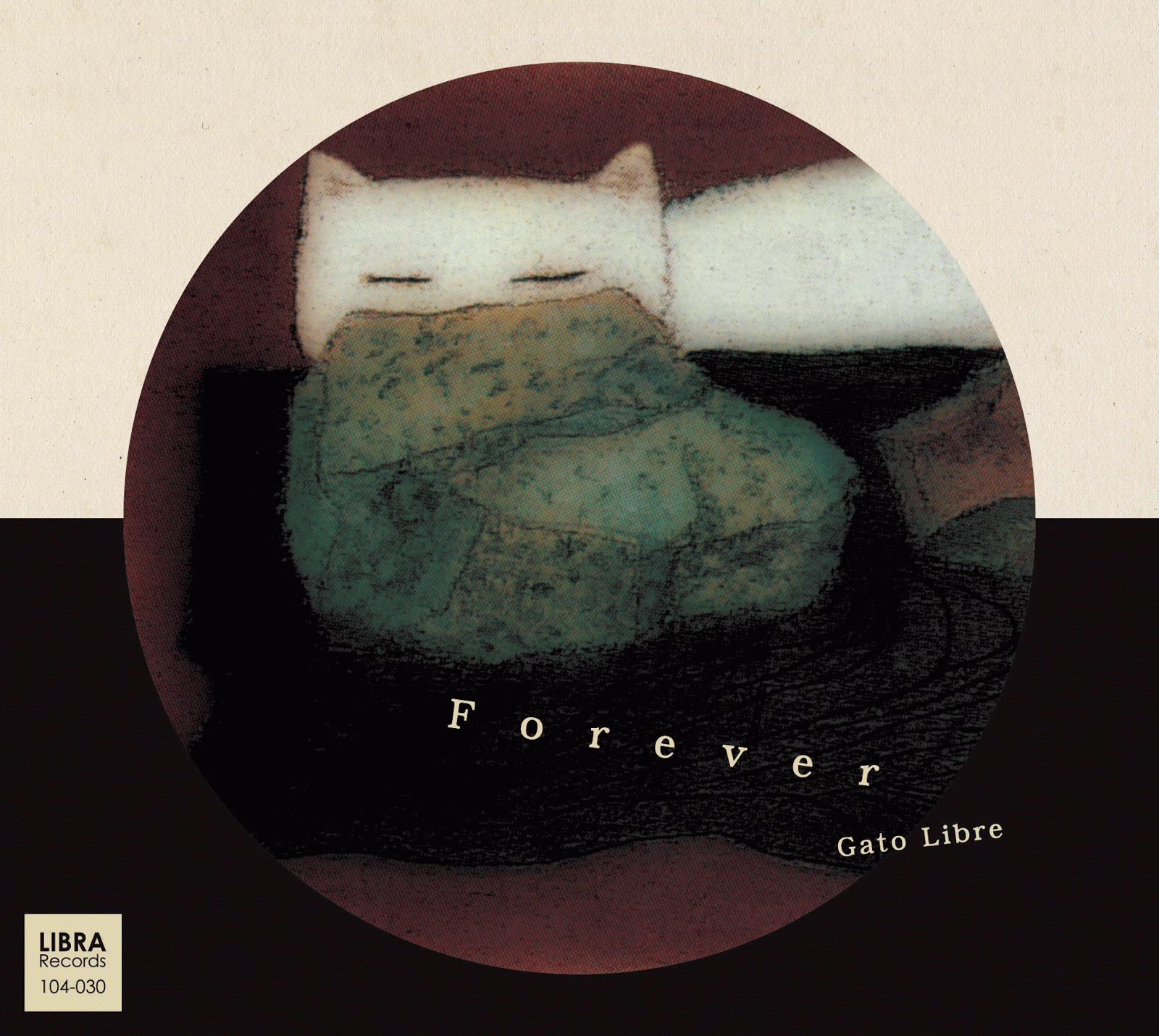
Gato Libre: Forever (Libra): Unless you reside in Japan, you're forgiven if the band's name doesn't immediately ring a bell. This is one of the multitude of projects that pianist Satoko Fujii is a part of, a quartet co-led with her husband, trumpeter Natsuki Tamura. Sadly, this album documents their final concert in their original lineup; bassist Norikatsu Koreyasu died just days after the performance. Even without that knowledge, there is a wistfulness that suffuses the music, accentuated by Tamura's Spanish-tinged playing. Fujii's spectral accordion work is a special delight here, as is Koreyasu's beautiful tone.

Vijay Iyer Trio: Accelerando (ACT): It's currently hip to knock journalists who give attention to Iyer (let alone give him an unprecedented number of DownBeat awards) rather than the dozen or so other youngish pianists who are incorporating multiple sonic elements and musical influences into their playing, but Accelerando is just too good to overlook. By now, it's a given that Iyer and his trio mates can dance cannily on variegated rhythmic streams. On Accelerando, they expand on the language, taking it to places that will have you returning again and again to hear their conversation.

Fred Ho and Quincy Saul: The Music of Cal Massey: A Tribute (Mutable Music): Cal Massey is not much known beyond his association with John Coltrane and other Philadelphia musicians, so plaudits to Fred Ho and Quincy Saul for showcasing his music, particularly the "Black Liberation Movement Suite" from 1969. Trombonist Frank Lacy is especially strong on the recording.

Henry Threadgill Zooid: Tomorrow Sunny/The Revelry, Spp (Pi): Still staunchly individualistic, Henry Threadgill sounds like no one else, and an opportunity to explore his innovative sound world is always welcome. Threadgill's music has assumed a slightly more austere manner than in the days of his Sextett, but it is no less compelling.

Nik Bärtsch’s Ronin: Live (ECM): A compilation of concerts by Swiss pianist Nik Bärtsch's band, this set rocks and grooves in inviting and mysterious ways. Like Threadgill's, Bärtsch's vision is firm enough that his music sounds immune from changes in personnel.

Dave Douglas Quintet: Be Still (Greenleaf): Dave Douglas' recordings are frequently conceptual, but none have been more personal than this dedication to his late mother. Using primarily hymns selected by his mother for her memorial service, Douglas adds the plainspoken voice of Aoife O'Donovan to create a distinctive blend of old and contemporary Americana.

Gonzalo Rubalcaba: XXI Century (5Passion): I have often found the Cuban pianist too rococo for my taste, but, here, his inclination to ornament every phrase pays dividends.  With Matt Brewer and Marcus Gilmore as a thoroughly modern rhythm section, Rubalcaba's piano weaves in and out of focus. In my four-star DownBeat review, I called this "smart, adventurous fun that works well on several levels."

Frank Kimbrough Trio: Live At Kitano (Palmetto): Best known for his quiet-but-sturdy work within the Maria Schneider Jazz Orchestra, Frank Kimbrough is an exceptional pianist with a rich imagination and a deep knowledge of jazz history that frequently colours his improvisations. But Kimbrough's not even the best thing here; that honour goes to drummer Matt Wilson, whose wit, ingenuity and daring are unparalleled.

John Abercrombie Quartet: Within A Song (ECM): Without apology, let me say that it's likely any recording guitarist John Abercrombie releases will find its way to my top 10 list, particularly when it includes drummer Joey Baron. While Abercrombie's recent albums have featured violinist Mark Feldman, here he teams with saxophonist Joe Lovano, and it's a toss-up who I prefer. The material—drawn mainly from iconic jazz artists of the '50s and '60s—is flawlessly executed. 

Bill Laswell: Means Of Deliverance: Solo (Innerrhythmic): Laswell's projects are usually teeming with sonic complexity, so who knew what to expect from his first solo bass recording. Beautiful and resonant, this is a recording that sounds both timeless and genre-free.

Thursday, December 13, 2012

Brubeck and Shankar: Genius Past 90

When an artist remains creative into his or her tenth decade there is a temptation to overstate the person's importance. Longevity has a way of clouding, or perhaps just softening, our critical view. In that regard, Eubie Blake and Doc Cheatham grew in stature with each passing year prior to their forestalled deaths. In essence, they seemed like stand-ins (on The Tonight Show with Johnny Carson and other high-profile venues) for one-time peers who actually had more of an impact, but had the misfortune of living shorter lives.

Ravi Shankar and Dave Brubeck—united in deaths just a week apart and several biographical details—were exceptions. They were vital, creative and influential until the very end.

If my memory serves, I heard Shankar sometime in the early '60s, courtesy of some of my parents' more adventurous friends. If it didn't really register for what it was at the time, that exposure laid the groundwork for easy acceptance of the sonic texture of the sitar when The Beatles incorporated it into their music a few years later.

I wrote last week of how Brubeck opened me to the concept of jazz as a place where the races could come together creatively. In that same way, the tonality of Shankar's music alerted me to the reality that there was a huge world beyond the western music I heard on a daily basis. What's more, Shankar's music was—prior to hearing Charlie Parker—my first exposure to other-worldly virtuosity. It helped me put rock guitarists in perspective. When my friends gushed over Eric Clapton, I pointed them to Shankar. Checking back on his appearance to open the Concert for Bangladesh, I was reminded of the frisson I felt in those days. As an example, dig the blazing exchanges between Ali Akbar Khan and Shankar at 4:36 and 4:51. If George Harrison took inspiration from Shankar's sound, surely guitarists like Duane Allman and Dickey Betts picked up an idea or two from riff trading like this.


Live exposure to Shankar was hard to come by where I grew up, but I took my mother—then, about 82—to see Shankar one night. We still talk about that concert as one of the times that our musical tastes met; a rare occasion.

In contemplating the death of these two giants so close together, I'm struck by a similarity that overshadows the fact that both men produced highly musical offspring. Both Brubeck and Shankar felt the sting of critics who labelled them as sell outs, thanks to their widespread popularity. In Shankar's case, it was more of a challenge, because it attacked him at the level of ethnicity and national pride. It happened early—an ego-shattering experience, he recalled—when he was performing with his brother's dance troupe in the mid-'30s, and then again, when The Beatles swept him up in their wake.

Both Brubeck and Shankar remained true to themselves and toughed out the criticism. They didn't buckle, and by overcoming their challengers they opened their music to much wider appreciation. Last week, Facebook was flooded with testimonials of how Brubeck opened musicians to new worlds beyond what was accepted in jazz, and those types of comments are now flowing for Shankar, too.

One other product of living 90-plus years is that people begin to take you for granted. Until you're gone. Only in retrospect, as we re-examine the careers of these giants, do we realize how much of the world as we know it was shaped by their contributions.


Wednesday, December 05, 2012

What Dave Brubeck Taught Me

Dave Brubeck was an enormous influence on my early jazz listening, and—along with his sidemen Gerry Mulligan and Paul Desmond—probably the only white jazz musician I listened to until Keith Jarrett and Chick Corea broke out on their own. If Brubeck was a jazz ambassador, taking American music to the Soviet Union and beyond, he was also an ambassador for a white kid in Canada, exploring. He looked like my dad. He was so square, he was hip.

I thought, okay, this music is universal; everyone can contribute. It was a big, open tent. That was an important thing to learn early on.

Skip forward 45 years or so, and I found myself working as the media relations resource for Ottawa's jazz festival one summer, with Mr. Brubeck slotted to headline our festival, accompanied by the entire National Arts Centre Orchestra before about 15,000 people on a spectacular summer evening. The concert was remarkable, but my best memory comes from earlier in the day.

Most headliners let their bandmates do the heavy lifting during soundcheck. The really big names sometimes don't show up at all. And if they are living legends in their late 80s?

I don't think we expected to see Dave Brubeck onstage that afternoon, yet there he was with his quartet, soundchecking as the hot summer sun beat down on the stage. We expected a rudimentary 15 minutes at most.

He started off wearing a jacket and white shirt, standard fare for anyone's elderly grandfather. But the soundcheck went on and on, his band working out nuances on pieces they must've played hundreds of times. The leader kept making adjustments, asking his guys to play things again.

The coat came off. The white shirt came off. There was Dave Brubeck, looking like a superannuated Bruce Springsteen in his undershirt, working his band hard through a full rehearsal. Smiling. Happy. Showing me that the joy of music is a gift you can keep forever.

So many lessons. So much memorable music.

Thursday, November 15, 2012

Behind The Curtain

Maybe it's human nature, but there's always a certain temptation to make things appear harder to do than they are, all in pursuit of the ultimate compliment: Wow! That's probably harder than it looks.

Sometimes, you just get lucky.

A case in point: recent family events put me somewhat behind schedule in completing an assignment for CBCMusic.ca on the development of Blue Note Records as one of the most recognized brands in popular culture. Two days before deadline, I had only one source lined up—former Blue Note artist Javon Jackson—and that was something of a 'gimme' since we're friends. I'd also promised my editor someone who could talk knowledgeably about what it takes to build and maintain a global brand and someone from inside Blue Note who could comment on how they manage the heritage that founders Alfred Lion and Francis Wolff developed between 1939 and the mid-'60s.

The first break was probably just timing: Blue Note president Don Was had an opening in his crazy schedule (you know, The Rolling Stones didn't need him in the studio that day, or something). Don was incredibly gracious and generous with his time, and gave me a great quote about how he manages Blue Note: "I just try not to make any shitty recordings."

It's tough to go wrong with a quote like that, and to make things even easier, Don repeated a story he had recounted to the New York Times about how he constantly refers to Lion's original mission statement for Blue Note.

The second break was more astounding. Here in Canada, advertising veteran Terry O'Reilly has become well known outside his industry with his extremely witty and insightful radio program Under The Influence. He's another busy guy, so I was very happy when he made himself available to respond to some email questions. Very nice, but what were the odds that he would know much about Blue Note Records? Turns out, he had not only done a lot of thinking about Blue Note and its brand, but he actually worked with legendary Blue Note designer Reid Miles back in the '80s. He had a ton of interesting things to say.

When you get good stuff like that, an article almost writes itself. You just have to make it look hard.

Check out the article here.

Monday, November 05, 2012

An Ode To A Man With Huge Ears

My father died two weeks ago at the age of 90.

He had a good life—charmed, actually, in many ways—and he was lucky to slide away from us without much suffering.

He left me with many, many things, as a good man who fathers you for 58 years will do, and the best of all things was his curiosity about music.

Here's what a typical Sunday morning sounded like at my house in the 1960s: I'd be awakened by the music of Glenn Miller, Duke Ellington, Benny Goodman, The Kingston Trio, Elvis Presley, or some faceless Hawaiian music. My father bought one of those massive, coffin-like stereo systems in about 1961, but he was smart enough to go with a Grundig system with really decent sound. That system, and the record club phenomenon of the time, led to him consuming an endless amount of LPs. My brothers were off to college, and they had left behind LPs by Gene Vincent, Elvis, Santo & Johnny, and all those groups that came along during the folk music explosion.

My dad didn't discriminate; he'd roll straight from GI Blues to a stereo demonstration record featuring Bob & Ray, to Goodman featuring Charlie Christian, to the soundtrack from South Pacific. Sundays streamed by, usually ending only when golf came on TV late in the afternoon.

One album my father had changed my life. It was called Two Of A Mind—a 1962 session featuring Gerry Mulligan and Paul Desmond. As noted, he listened to a lot of big band music, or by Goodman's small sub-groups, but the Mulligan/Desmond LP was the first thing I heard him play that captured a contemporary sound. It was also one of the few records he played that I went back and checked out myself. From there, it wasn't a big step to a Charlie Parker collection that a sax-playing friend of mine brought over one day after school. The rest, as they say, is history.

Perhaps the best thing about the way my father exposed me to music were the stories he told me about the musicians. He loved to tell stories, and the music provided a great backdrop to his tales of Frank Sinatra's early years, or Goodman's efforts to convince his parents that a jazz career was a worthy goal. He might've scoffed at Elvis' hair, but he never put down his music.

In effect, he taught me what I needed to know when I landed a job hosting a show on a campus FM station in the late 1970s.

My father with his latter-day turntable
Let's not gloss things over; he disagreed with a lot of the things I listened to when I was in my teens. He told me to turn down The Allman Brothers Band more than once, and said that Muddy Waters sounded like he had a headache, and was giving him one, too. He once asked me what I thought hours of listening to music was going to do for me, but he balanced that years later by showing real pride in the career I built for myself as a music journalist.

One of the best things about my father's long life was that I had a chance to share a lot of music with him when I was an adult. I particularly recall taking him to see his hero, Goodman, at one of the clarinetist's later concerts. I don't think I can remember my father having as good a time outside of family gatherings. Very recently, when he was really in failing health, he was still interested and alert enough to enjoy some first-hand stories about Goodman I learned from one of his sidemen.

I wish I could say that I've been as influential on my own two daughters' musical education. Sadly, that's one of the things that fathers have lost control of, thanks to the advent of cheap personal listening devices. Back in the 1960s, you could do a lot worse than waking to Ellington, and having the stereo controlled by someone with as much curiosity and wisdom as my father.

In Ottawa's Hintonburg, Worlds Collide and Stomachs Win Over Ears

Aside from jazz, one of my favourite interests is cities and how they develop, and no city attracts my interest more than my own.

I grew up just to the west of a working-class neighbourhood in Ottawa, which was known variously as Mechanicsville and Hintonburg. In recent years, the area has been undergoing sweeping change, with small, contemporary restaurants replacing decades-old KFC outlets and independent greasy spoons. Consequently, the area has attracted a growing number of young families, artists and technology workers, who have taken over the densely packed houses that straddle the main artery. For those of us who grew up in the years when the neighbourhood was anything but a destination, the change has been heady.

One of the cornerstones of the neighbourhood's change has been the Elmdale House Tavern, one of the last of the city's traditional beer parlours (which, as recently as the 1970s, featured 'Men's' and 'Ladies and Escorts' entrances and strictly segregated service policies). A few years ago, a couple of neighbourhood veterans bought the 80-year-old business, replaced the heating/cooling system and other infrastructural elements, and launched a six-night-a-week live music policy—the first of its kind in Ottawa in many years. While the booking policy only occasionally extended to include jazz artists like Charlie Hunter, the musical menu was eclectic, and the opportunities for young bands legion.

Meanwhile, across town, in another once-dodgy neighbourhood, another dedicated, young entrepreneur was shaking things up with a funky restaurant that offered sustainably sourced seafood and employed some of the city's most creative chefs. But, while the Elmdale House maintained the down-and-dirty essence of its roots, and kept prices low to build its audience, the Whalesbone Oyster House offered main courses that scrape the $50 mark and attracted high-flying Cabinet ministers from Canada's federal government.

Now, Ottawa's music and food scenes are abuzz with news that Whalesbone owner Joshua Bishop has purchased the rights to the Elmdale House business and announced plans to reduce the live music by 60 percent, cut the seating capacity from 160 to 95, and add a kitchen to the old structure.

Worlds collide and sparks fly. Foodies and music fans are choosing sides and flinging tweets that knock opposing views.

I'm a fan of Whalesbone and its sustainable fish, but I'm mourning the loss of this important music venue. Ottawa has always had a problem with sustaining a full-time music scene—being sandwiched  between the much-larger scenes in Montreal to the east and Toronto to the west—and the Elmdale House was going a long way toward turning that around.

In this case, it's clear that the foodies have won out and musicians and their fans are on the losing end.


Friday, October 19, 2012

David S. Ware 1949-2012

Photo by Michael Jackson
Wasn't that a man?

David S. Ware made a mighty sound, and was one of those musicians whose soulfulness was evident in every note he played.

At times, he seemed to be indomitable. I saw him once at the Victoriaville festival just after the taxi cab he drove had been broadsided in an accident. Ware was on crutches, and in obvious pain, but he put everything he had into his playing. He always did.

The fact that he seemed to rebound from a kidney transplant was no surprise, but in the end he couldn't beat the disease.

There is a big outpouring of love for Ware around social media today, and I believe a large part of the connection people felt to him was the fact that he was a bridge to the giants (John Coltrane and Albert Ayler) that many of us didn't get to see in their prime. Ware was a worthy heir to their no-holds-barred sonic attack, and he attracted a large number of young fans who grew up listening to various genres of electric rock music. He welcomed them all, and introduced them to young musicians like Matthew Shipp and Susie Ibarra, helping to propel their careers into a broader realm.

David S. Ware: Big spirit. You will be missed.

Sunday, October 14, 2012

Jazz In Canada's Walled City

Heading off this week for the sixth Quebec City International Jazz Festival, which always forms a nice bridge between the end of the summer festival season and Winter Jazzfest in New York City.

Festival founder Gino Ste-Marie and his crew continue their tradition of focusing on a single instrument. This year, it's the trumpet, with featured guests Ingrid Jensen, Arturo Sandoval, Jeremy Pelt, Christian Scott, Paolo Fresu, Erik Truffaz, Tiger Okoshi, Joe Sullivan and Ron Di Lauro. Other highlights include Robert Glasper's Experiment, Gretchen Parlato, Ran Blake and the duo of Marc Copland and Gary Peacock.

It's been interesting to track the growth of this festival over the past few years. This year's event spans some 20 venues, spreading the music throughout Quebec's capital city.

I'll be reporting for DownBeat's website, as well as posting some comments here.

Tuesday, October 02, 2012

Taking Stock

With October upon us I suppose it's time to take a quick scan across the 2012 releases, with a view to getting some idea of how tough it will be to assemble a top 10 list. Some years, the cream just rises to the top, and there's not much of an issue with seeing a broad divide between the best and the rest. I get the feeling that this is not one of those years. Let's look!

Yup, my memory didn't fail me; I had earmarked seven great CDs prior to May, and I've definitely heard as many terrific things since then.

So, some early contenders: Obviously, that long-lost recording by Keith Jarrett's European quartet is high on the list, as is arranger Ryan Truesdell's exploration of equally obscure material by Gil Evans. Hard to overlook the recordings by Henry Threadgill's Zooid and Vijay Iyer's trio, and that Blue Note recording by Ravi Coltrane was full of great music.

Just recently, I was bowled over by a new live recording by the Japanese quartet Gato Libre, which I've reviewed for an upcoming issue of DownBeat, and I've loved what I've heard of Dave Douglas' new quintet, though I haven't heard the actual recording yet, just the video and a live NPR set. And then, there are a bunch of real dark horses; in fact, I can't recall a year when the contenders have included so many artists that I've never placed on a year-end poll before.

Some hard decisions ahead, but I'm looking forward to listening to it all again.

Addendum: The Dave Douglas arrived, and lived up to its promise. Oh, and then Joe Lovano had to go and release a new CD, too. But the real surprise in the past couple of weeks has been the live album by Nik Bärtsch's Ronin.

Wednesday, September 05, 2012

Thriller At Thirty

Back in the early 1980s, liking Michael Jackson could get you hurt.

At that time, I hosted a Saturday evening radio program on CKCU-FM, Canada's longest-running campus station. I took over from the station's hard-core reggae program in the afternoon, and handed off to a program highlighting the week's best new albums at 8 p.m. The idea was to warm listeners up for whatever their Saturday night held for them, and I leaned toward the power pop of the day (Graham Parker, Elvis Costello, Joe Jackson, Any Trouble, and the like) and mixed things up with classic American roots music, running from Gene Vincent to Joe Ely.

One evening, I got the urge to hear the Jackson Five's "ABC," possibly inspired by Parker's cover of the band's "I Want You Back."

The Saturday evening show elicited a lot of phone requests, so I thought nothing of it when the light flashed as the first chorus of "ABC" was ending.

"Hey, you asshole, what is this bubblegum shit you're playing?"

Usually, you could disarm an abrasive caller with some humour, but this guy wasn't buying that. After some escalating dialogue, he promised to meet me in the parking lot after my show to express his dislike of the Jacksons with his fists.

I think his unfulfilled threat was on my mind in November 1982, when I was filling in for someone—perhaps my late friend Brian Eagle—on a mid-week afternoon show. The record rep from CBS had just dropped off the label's new releases, and the program manager brought them into the on-air studio. I flipped through them and spotted the long-overdue release by Michael Jackson: Thriller.

Its 1979 predecessor, Off The Wall, had contained some great pop-dance music, but hadn't been any more welcome at CKCU than "ABC" was. 

I casually scanned the credits, and did a double-take when I saw Eddie Van Halen's name beside "Beat It." The record I was playing was coming to an end. I had the Jackson vinyl out of the sleeve. I decided to play it without auditioning it. I turned up the JBL speakers in the studio, and the program manager and I smiled all the way through that brilliant Van Halen solo.

I don't know if I was the first DJ to air Thriller in Canada, but I suspect I was. It was certainly probably the first broadcast of "Beat It" since the song was not designated as the album's first single. I've thought of that a few times over the years—including once when I found myself commenting on a different radio station the morning after Jackson's death—but this article in the New York Times shines an interesting light on how Thriller went from curiosity to blockbuster.

Thursday, August 09, 2012

Jazz Festivals From The Journalists' Side

Next to receiving free CDs, covering a jazz festival is likely the ideal thing that people think of when/if they consider how great it would be to work as a jazz journalist. The reality—like the reality of dealing with thousands of uninvited pieces of plastic—is somewhat different.

Like every other jazz-loving kid, I enviously read dispatches from Montreux and Newport, and dreamed of being 'on assignment'. But my first actual experience with jazz festival journalism was practically begging reporters to come out to cover the festival I helped manage in my hometown of Ottawa. During the festival's first decade—in the 1980s—no journalists were beating down our doors, scrambling for media credentials.

In 1991, the tables had turned, and I talked the arts editor of The Ottawa Citizen into letting me cover the same festival (whose employ I had left in 1989) the way I thought a festival should be covered. By the end of that year's 10-day festival, having cranked out thousands of words on very tight deadlines, I was begging to be put out of my misery. How many more versions of "Round Midnight" could I parse for meaning?

It turns out that reporting on a festival is even more work than managing one. Few reporters have the stamina of my friend John Kelman, the seemingly indefatigable AllAboutJazz.com editor who has become a one-man festival wrecking crew. Approaching an extended festival, which usually has multiple strands of musical genres and performance venues on display, takes strategy. That keeps your critical faculties fresh, but it also helps ensure that readers/listeners aren't overwhelmed by a torrent of words about dozens of acts. A good festival dispatch requires shape and sound structure.

On Wednesday, August 15, at 8 p.m. Eastern, several of us will be discussing the art of jazz festival reporting in the second of an ongoing series of webinars organized by the Jazz Journalists Association. Attendance is free, but registration is required. You can read more about the event, and register, here.

Tuesday, July 31, 2012

Revisiting Euro-Jarrett

Perhaps I was too enraptured by his so-called American Quartet or too much in love with his rapturous solo inventions of the 1970s, but I never delved too far into Keith Jarrett's 'European Quartet' with Jan Garbarek, Jon Christensen and Palle Danielsson. The band struck me as cold and rather academic in comparison to Dewey Redman's squawking raunch, Charlie Haden's deep grooves and Paul Motian's effortless swing.

So, if you've been lucky enough to hear Sleeper, the 1979 concert that ECM released last week, you know what a slap in the head I've taken. I've long since become a huge fan of Garbarek (many thanks to my late friend Eric Nisenson for hipping me to the saxophonist's great works) but his gruff, extended blowing here is still a revelation. On "Chant Of The Soil" and "New Dance," he takes Jarrett's music as out as Redman ever did, but with more connection to the melodic core of the compositions. In concert, the Latin grooves of "Personal Mountains" and "New Dance" have a slippery essence that I wasn't expecting.

What a joy it is to discover exciting music like this 33 years after the fact. I'll just try not to kick myself too often for missing it all this time.

Wednesday, July 11, 2012

A Death In The Family

When a standalone restaurant closes, it's usually a highly local story. But, when that restaurant doubles as the headquarters of a city's jazz scene, it's a death that affects us all in the music community.

Café Paradiso was one of those places; a singular jazz venue in a mid-sized Canadian city that has proven incapable over the past 40 years of sustaining more than one jazz club at a time—often with gaps of many years between their deaths. Its closure on June 30—less than two weeks after playing host to a Jazz Hero satellite party for the Jazz Journalists Association Jazz Awards, and immediately after a performance by vocalist Theo Bleckmann and guitarist Ben Monder—leaves a big hole in the club circuit that exists just north of the Canada/U.S. border, in Toronto, Kingston, Ottawa, Montreal and Quebec City. Its presence allowed artists like Bleckmann, Sheila Jordan and Dave Liebman to make economic sense of venturing north of New York City, hooking up single-night gigs in places like Montreal's Upstairs and Quebec City's Largo in addition to a night at Paradiso.

Recently, on Facebook, I sang the praises of club owners like Upstairs' Joel Giberovitch, Largo's Gino Ste-Marie and Paradiso's Alex Demianenko—impresarios who are in the business for their love of the music, rather than simply restaurateurs who think they can make a buck off hungry and thirsty jazz lovers.

Roddy Ellias at Café Paradiso in June
I barely knew Demianenko, but let me tell you what I learned about him in a short time. My jazz critic colleague Peter Hum introduced me to him one afternoon in April. I told Demianenko I wanted to talk to him about possibly holding the Jazz Hero event at his club. He asked me to step into the small passageway between his bar and kitchen, and I made a four- or five-minute pitch to him about the Jazz Journalists Association and the Jazz Hero concept. He'd never heard of the association or its annual Jazz Awards, but he listened intently, nodding his head, and said, "I'd love to do it. I'll pay the band."

Now, the most Hum and I had hoped was that a club owner might offer us the space and allow us to invite some local musicians up to jam, but here he was offering to pay for a band to play on what would normally be an off-night for his club.

Maybe that's the kind of risk-taking that led to Paradiso's closure, but it's also the kind of generosity that you see too little of in the world of jazz clubs.

As noted, Ottawa has seen them come and go over the years: The Penguin, Woody's, Take Five, After Eight. If you've been around town long enough, it can seem like a sad roll call of faded dreams.

But, here's one to dreamers like Alex Demianenko; they keep the jazz world turning.

Monday, July 09, 2012

A Band Is Born

There are few things as thrilling in music as when musicians whose work you love form a new group and the results define the cliché of the whole being greater than the sum of its parts.

The new Dave Douglas/Joe Lovano quintet—known as Sound Prints, in subtle homage to Wayne Shorter—is just such a thrill. With the sublime Joey Baron on drums, Linda Oh on bass and Lawrence Fields on piano, the band already sounds fabulous, and it's really just starting out. It's now in the midst of a European festival tour, before returning home to play Newport and Detroit in the late summer, and finally making it to the Village Vanguard in the fall. One can only hope that the Vanguard date will be recorded.

I caught the band's second official gig (a version of the group played in Boston with James Genus on bass late last year) on this summer tour, and my review of two sets is up today on the DownBeat website.

Wednesday, July 04, 2012

The Graying Of Jazz

The main stage structure in Ottawa's Confederation Park—home base for the TD Ottawa International Jazz Festival—has only just been dismantled, but the pundits are already debating what transpired there over the event's 10 days.

Ken Gray, a former editorial board member at the city's major daily and ongoing columnist, is a man who loves to lounge in the park and listen to music, and as he writes here he's willing to see the festival die a slow death rather than be subjected to music that he feels doesn't belong. My estimable colleague Peter Hum takes him on through the digital pages of the same newspaper.

Like many critics, Gray is only too happy to tell you what he doesn't like—anything that he feels smacks of pop, rock or blues—but is woefully short on opinions of just who might fill the bill to keep vacationing public servants and retirees nodding their heads and making trips to the beer concession as the festival sails toward the inevitable sunset of his doomsday scenario. He's also woefully blind to everything that goes on away from the festival's main stage (which, this year, included what was perhaps the best set of improvised music—performed by the new Dave Douglas/Joe Lovano quintet—I've witnessed in a couple of years anywhere) and how much those shows are subsidized by the 11,000 or so music fans who show up outdoors to hear the likes of Robert Plant or Steve Martin in all their non-jazz glory. In an earlier entry, I highlighted how much popular mainstream acts contribute to the coffers of the festival, which often loses money on jazz acts (the second set of that stellar Douglas/Lovano band attracted only about a one-third house, for example).

Of course, Gray also overlooks the reality of history. He falls back on that old saw that jazz never sounds better than it does on a summer's evening when it's played outdoors, presumably casting his mind back to the archetypal summer jazz fest at Newport, Rhode Island. Conveniently, he overlooks the fact that promoter George Wein—in addition to popularizing the concept of the outdoor jazz festival—also pioneered the inclusion of popular artists who drew from the same roots as Dizzy Gillespie and John Coltrane. Hence, Wein's inclusion of acts like Chuck Berry and, a decade or so later, the Allman Brothers Band, in the Newport Jazz Festival lineup.

No, Gray would rather see the festival shrink, or even perish—a vision that is not only ridiculously shortsighted, but diminishes the contributions of the artists who are performing in venues that promote close listening.

With 'fans' like that, is it any wonder that so many younger musicians reject the notion of jazz altogether?


July 8 Addendum: Here's an interesting perspective on the crux of this issue from pianist Robert Glasper, who believes jazz as the purists like Gray see it is a "secret club."