Thursday, July 18, 2013

Peter Appleyard, 1928-2013


A couple of years ago, vibraphonist Peter Appleyard released an album of terrific material he recorded with an all-star group in 1985. At the time, I interviewed him at length, and put together the following overview of his career. Like many English-born men of his time, he was a complete gentleman, but he told hilarious stories, including a great one about spending the night—listening to records, and nothing more he assured me—with Ava Gardner. His late night caused him to be late for a rehearsal with Benny Goodman the next day. It was the one-and-only time that Goodman shot him the infamous ray that so many Goodman sidemen talk about, but it was because the bandleader didn't believe that all they did was spin records. Peter Appleyard, you will be missed.

Stretching across more than 65 years, Peter Appleyard’s musical career has more than enough twists and dynamic evolution to form the libretto for an opera.

Born August 26, 1928 in Cleethorpes, England, a small community on the country’s east coast, Appleyard began as a drummer in the Boys’ Brigade near his home. Apprenticed as a compass adjustor, he became a professional musician when he joined Felix Mendelssohn’s Hawaiian Serenaders for £17 per week.

After an 18-month stint in Royal Air Force bands and the purchase of a small set of vibes for £15 from a man who turned out to be a British spy, Appleyard departed in 1949 for a hotel gig as a drummer in Bermuda. Missing a flight connection in New York City allowed him to visit Bop City in Midtown Manhattan, where Lionel Hampton was sharing the bill with George Shearing. Seeing Hampton improvise 10 choruses of “Stardust” set Appleyard’s course. He acquired a full set of vibes and spent every spare minute of his 18 months in Bermuda practising.

In 1950, Appleyard emigrated to Canada, arriving in Toronto at a tremendously opportune time: the decade brought a new liberal attitude to the city, and with it a number of new bars and clubs. After a year out of music—awaiting the issuance of a union card—Appleyard plunged back in, attending jam sessions at the Baldwin Club, gigs at the Colonial Tavern and listening parties where he rubbed shoulders with the likes of Duke Ellington and Clark Terry. A regular job with American expatriate pianist Calvin Jackson brought television exposure and a high-profile gig at the Park Plaza Hotel. Jackson’s band also worked as far afield as New York City, where it appeared opposite Oscar Peterson and Ella Fitzgerald, and Chicago.

After splitting with Jackson in 1956, Appleyard started his own band and entered a busy period of commercial work, expanding his arsenal to include tympani and appearing frequently on television and radio across Canada.

In 1972, his career took another dramatic turn. A casual conversation with Benny Goodman backstage in Toronto led to him joining the renowned bandleader for eight years of globetrotting tours, and paved the way for Appleyard’s formation of a Goodman tribute band in 1985.

In addition to Goodman, Appleyard has accompanied headline performers like Frank Sinatra and Mel Tormé, and toured the world under his own name and as a co-leader with pianist Dick Hyman.

Looking back, Appleyard mused: “When I was starting out, I never dreamed I would even see Benny Goodman, let alone play with him for eight years. The music keeps me going. I would still travel miles to play.”

Saturday, June 29, 2013

TD Ottawa Jazz Festival: Day 9

It doesn't get much better than catching two of my favourite young musicians in one of my favourite venues, especially when a cold rain is tumbling down outside.

If there's justice in the jazz world, pianist Marianne Trudel should be on the edge of a breakout. She is playing with confidence and creativity, and her compositions bristle with fresh ideas and a real sense of purpose. Check out her playing here, performing with trumpeter Ingrid Jensen at a show I caught last October at Quebec City's now-defunct Largo Resto-Bar.

She brought her new trio—Trifolia—to the National Arts Centre's Fourth Stage on Friday evening, and delivered a highly charged performance that featured a handful of new pieces by herself and bassist Etienne Lafrance. It's music filled with interesting textures, largely due to percussionist Patrick Graham's distinctive set-up, which includes everything from plastic wind whistles to bowls of water. The bass percussion is delivered by a combination of hand drums and cajon, so it's a light, fluid sound that's constantly shifting. Trudel joked that Graham was known as the "Paganini of the tambourine," (better that than the "Pavarotti of the tambourine," suggested my buddy Peter Bunnett from the audience) but his dexterity with the instrument is serious stuff. More texture is added by Trudel's use of a small accordion, which she introduced with a touching story about finding it in her grandfather's basement.

The band is finishing an extensive tour of Canada in mid-July. One can only hope that it finds a broader audience, too, because it is playing exceptional music that deserves to be widely heard.

Another young woman whose early I've followed with interest is guitarist Mary Halvorson. Friday's performance with drummer Tomas Fujiwara's Hook-Up found her deep into a Sonny Sharrock mode, adding harsh, variegated bursts of feedback—along with her trademark octave bends and aggressive chording—to the band's strident sound. With trumpeter Jonathan Finlayson and tenor saxophonist Brian Settles up front, and the formidable Michael Formanek on bass, the quintet painted with bursts of sonic energy, Fujiwara displaying both power and grace.


Friday, June 28, 2013

TD Ottawa Jazz Festival: Day 8

It's akin to the so-called 'fog of war.'

When proponents dig in on two sides of a debate, some key facts get lost.

It follows that one of the things that was lost when bebop came to dominate jazz in the years following World War II was the primacy of jazz as social music. With its radical chord substitutions and lightning tempos, bop was music for close listening rather than dancing. By the time it reached the mainstream, bop was characterized as intellectual music, and many that aped the innovations of Charlie Parker, Thelonious Monk, Bud Powell, and Dizzy Gillespie ignored the fact that each of those musicians had deep roots in rhythmic music. When Louis Armstrong objected to the movement, battle lines were drawn, and the 'mouldy fig' epithet was thrown.

In reality, the 'fig' designation was about as accurate as the belief that all boppers favoured berets and goatees.

Those with longer vision see past these types of cultural reductions—many of which were imposed by popular media outlets. In the '70s, Henry Threadgill, David Murray and others looked back 50 years to some of the roots of African-American music in the 20th century, and now Jason Moran is mining the genius of Thomas (Fats) Waller to create a hybrid of social music that channels Waller's compositions through the lens of hip-hop.

With longtime trio partner Tarus Mateen on bass and Meshell Ndegeocello as occasional bassist, poetess and onstage director, Moran brought his Fats Waller Dance Party to Ottawa's Dominion-Chalmers United Church for an early evening concert on June 27. On the previous Sunday, Mavis Staples had packed the church, so perhaps it was the mid-week timing that accounted for the small crowd that turned out. A number of those people fled during the first couple of songs—perhaps due to the way the sound of Moran's amplified quartet boomed through the large church, muffling the sound of singer Lisa Harris and deadening the effect of the rhythmic infrastructure.

Things shifted sharply when Moran donned a large Waller mask—all bowler hat, raffish eyebrows, toothy grin, and cigarette—and the band kicked into Babatunde Olatunji's "Jin-Go-Lo-Ba" (better known to many music fans as "Jingo" in the form that Santana recorded it on its debut album). With the rhythm more elemental than the reinterpretations of Waller's stuttering tempos, some of the audience members jumped up to dance along.

Moran also reminded listeners that he is, first and foremost, one of jazz's most gifted contemporary pianists, performing exceptional solo renditions of Waller's "A Handful Of Keys" and "Lulu's Back In Town."

Although the band never really overcame the acoustics of the church (a closing "The Joint Is Jumping" lost much of its power in the mix) it succeeded in connecting the dots between what Waller set out in the '20s and '30s, his roots in the church, and contemporary rhythms.

Thursday, June 27, 2013

TD Ottawa Jazz Festival: Day 7

It is beyond cliché to say that jazz is akin to a conversation, and often not true. In many bands—especially during festival season, when travel woes are at their worst—musicians can be seen going about their work all but unaware of what their bandmates are doing. Some veterans seem to be particularly isolated.

Twice during Wednesday evening's concert inside the National Arts Centre's Studio, 75-year-old pianist Steve Kuhn thanked the capacity audience for supporting "this music we have devoted our lives to." With irrepressible Joey Baron on drums and Steve Swallow on electric bass, the trio also seemed devoted to having fun. It's not unusual for Baron to have a smile on his face during a show, but he, Swallow and Kuhn continuously shared laughs and looks of appreciation at what the others were doing.

For anyone new to the music, I recommend the sight of the grizzled, gnomish Swallow, hunched over his instrument and spinning out supple lines filled with gloriously round notes. The sound he achieves continues to be one of the most beautiful in jazz.

Aside from Henry Mancini's "Slow Hot Wind" (also known as "Lujon") a slow, sensuous "Stella By Starlight" and an opening standard, the trio's program was divided between compositions by Swallow and Kuhn, including the bassist's gorgeous tune "Eiderdown." It is material they have often played, drawn largely from the four ECM albums they have made in some combination of the trio, but their enthusiasm and commitment to the moment ensured that everything sounded like they were making discoveries at each turn in the music.

Monday, June 24, 2013

TD Ottawa Jazz Festival: Day 4

In Canada, the myth about top-rank musicians has long been that, once they relocate to Toronto, they become part of a homogenous whole, playing and recording music that all sounds the same.

Don't believe it.

Tenor saxophonist Mike Murley literally blew that fable away with a stunning reinterpretation of the Irish war lament "Shule Aroon" that held echoes of John Coltrane's "Alabama," with drummer Ted Warren roiling behind him and bassist Jim Vivian strumming a pedal point darkly. Both Murley and Vivian moved to Toronto from Atlantic Canada (Murley from Nova Scotia, Vivian from Newfoundland and Labrador), and while they assimilated themselves into a group of musicians who have dominated jazz in Canada over the past 30 years, their Celtic roots are often on display.

Murley's septet is strong at every position, particularly piano, with David Braid finding distinctive voicings and soloing beautifully.

Outdoor concerts often hold the threat of inclement weather, and the Ottawa Jazz Festival has had more than its share of mainstage shows where weather played a factor: from the frigid rain that drenched a huge audience during a Wayne Shorter/Herbie Hancock show to a literally steamy field of grass that faced The Bad Plus one sultry Sunday afternoon. That said, no one in the media trailer—where a number of us took refuge from a hard downpour during David Byrne/St. Vincent—could recall a show being interrupted for 20 minutes to allow a lightning storm to abate. But, then, how many other festivals feature a headliner (singer Kellylee Evans) who was recently struck by lightning while standing in her kitchen? The memory of the 2011 stage collapse at Ottawa's Bluesfest during a Cheap Trick concert was also fresh in everyone's memory.

The break didn't do anything to lessen the impact of what had gone before—more than 60 minutes of tightly arranged, hard rocking fun from the former Talking Heads frontman and 30-year-old Annie Clark, the compellingly oddball guitarist and singer from Oklahoma. Backed—and sometimes surrounded—by a New Orleans-style horn section, Byrne and Clark performed a strong mixture of songs from their joint album Love This Giant and other pieces, like Clark's "Cruel."

Although many of the faithful braved the lightning and heavy rain, when the show resumed, its momentum had been sapped. What should've been an over-the-top encore (a much anticipated Talking Heads party song; in this instance "Burning Down The House") was somewhat anti-climactic.

Saturday, June 22, 2013

TD Ottawa Jazz Festival: Day 2

When the TD Ottawa Jazz Festival announced its lineup in late winter I dubbed it the Year of the Voice because of the number of highly distinctive singers who were featured: Willie Nelson, Mavis Staples, Aretha Franklin (who since cancelled), David Byrne, and Patricia Barber among them.

I hadn't counted on discovering Monica Akihary, a Dutch vocalist of Austral-Asian heritage. Co-leading the quartet Boi Akih with guitarist Niels Brouwer, she covers a wide range, from soulful crooning on Bob Marley's "Redemption Song" to hyper-glottal wordless improvisation. Even better, her rich vocals are mirrored by the expressive playing of trombonist Wolter Wierbos, who delivered some memorable work on two Jimi Hendrix compositions: "Drifting" and a radically deconstructed "The Wind Cries Mary." Even though some of the band's equipment didn't arrive until midway through its performance, Akihary maintained the flow of the set and its sense of focused surprise.

I doubt that festival programmer Petr Cancura knew there was a connection between Boi Akih and Chicago drummer Mike Reed's People, Places and Things, who followed the Dutch band into the National Arts Centre's Fourth Stage. If he did, then kudos for a canny booking decision; if not, then it was one of those lucky accidents that sometimes push festivals to a higher level.

As it turns out, Reed's quartet—featuring the powerhouse bassist Jason Roebke and simpatico saxophonists Greg Ward and Tim Haldeman—has spent considerable time in Amsterdam, and recorded a forthcoming album with some of the leading Dutch improvisers, including Wierbos. The trombonist joined the band for a pair of pieces that illustrated his mastery of plunger mute, and his presence added a new dimension to a band whose incessant road work has made them a ferocious unit with unerring instincts for blending their voices.

From the high intensity improvisation of Reed's band it was huge step to the late-night tent adjacent to Ottawa's city hall and the delightfully weightless voice of Aoife O'Donovan, the Celtic/bluegrass singer who seems on the verge of breaking through to a much larger audience. Best known by jazz fans for her contribution to trumpeter Dave Douglas' album Be Still, O'Donovan has the kind of gorgeous vocal instrument and effortless charm that Emmylou Harris displayed when she first moved from beneath the shadow of Gram Parsons. The tent was not the most favourable setting for her gentle voice (ironic, since the last time she performed in Ottawa—with the band Crooked Still—she, along with guitarist Richard Thompson, had been drowned out by Dweezil Zappa's over-amped tribute to his father) but her band was loud enough to cut through the incessant chatter of those reliving the night's Willie Nelson concert even if the lyrics of her new batch of songs were mostly lost in the din.

Friday, June 21, 2013

Kyoto Kudos To Cecil Taylor

Congratulations are due to pianist Cecil Taylor, recipient of the Kyoto Prize from the Inamori
Foundation for "fully exploring the possibilities of piano improvisation." As his citation reads:

"One of the most original pianists in the history of free jazz, Mr. Cecil Taylor has developed his innovative improvisation departing from conventional idioms through distinctive musical constructions and percussive renditions, thereby opening new possibilities in jazz. His unsurpassed virtuosity and strong will inject an intense, vital force into his music, which has exerted a profound influence on a broad range of musical genres."

I am hard pressed to think of a living artist who challenges me as much as Taylor, and who does so on so many levels. His music has brought me tremendous joy, and caused me to think hard. What more can you ask of an artist?

I have written frequently of him here, beginning with this post.

The Kyoto Prize brings with a cash award of some USD$500,000. As someone who has sometimes struggled to sustain himself as a creative artist working on the margins, no one deserves this kind of reward more than Taylor. Quirky, confounding (especially if you've ever tried to book him) and justifiably demanding, Cecil Taylor is a treasure, and it is good to see him recognized while he is alive to enjoy it.

Wednesday, June 19, 2013

My 10-Day Plan: Life Is Just A Jazz Festival

As summer officially begins, I'll be settling in for 10 days of music at my hometown jazz festival, the TD Ottawa Jazz Festival. This time of year often finds me heading off to other festivals on assignment, but sticking close to home I'll be making my own choices about what to see and hear. Here's where you'll find me:

June 20
Dr. John & The Nite Trippers – I came to Mac Rebennack's music courtesy of the late FM DJ Brian Murphy, around the time that the New Orleans singer and pianist was dressing in feathers and glitter and trading on the mystery of Louisiana folklore. In those years, Rebennack's band featured some of the young heavyweights of the Southern rock scene, and they did a great job at stirring up a stew of spacey sounds on songs like "I Walk On Gilded Splinters." Rebennack has moved in many directions since then, and lifestyle choices have not always made for the strongest music. But, like many other musicians his age, Rebennack has cleaned up and rejuvenated himself, and he's sounding better than he has in years.

June 21
Mike Reed's People, Places & Things – A couple of years ago, at the annual Winter Jazzfest in New York City, the buzz among my fellow music critics was all about drummer Mike Reed. In part, this was because New Yorkers can't stand to be behind the curve, and they wanted to see if someone based in Chicago was as good as his advance rep. The other part was just how good Reed's rep is, and the fact that his band includes other promising young players. Reed is one of those drummers who break the stereotype; not only leading a band, but writing compelling compositions that reflect the music's heritage and help move it ahead.

Aoife O'Donovan – Those who follow American roots music—particularly the strands that lean toward bluegrass and Celtic heritage—already knew about the power and suppleness of Aoife O'Donovan's gorgeous voice before she was selected by trumpeter Dave Douglas to join his band for his album of traditional hymns. I've since watched her perform her own music via NPR's video stream, and I'm looking forward to hearing more of her captivating material. O'Donovan has a deep well to draw on (she studied at the New England Conservatory of Music) and represents a broad cross-section of American music.

June 23
Mike Murley Septet – There was a time when Canada's leading musicians—who, for the most part, live in Vancouver, Toronto or Montreal—could afford to take their bands to other parts of the country throughout the year. Thanks to cuts to government funding and rising transportation/accommodation costs, those days are gone, so this is a welcome opportunity to catch up with saxophonist Mike Murley and some of the other great mainstream players—including Kevin Turcotte, Jim Vivian, and Ted Warren—who live in Toronto.

David Byrne & St. Vincent – Guitarist Annie Clark knocked me out the first time I heard her, and I've been a fan of Byrne's since the Talking Heads' debut album. Remarkably, I've never seen Byrne live, so I'm anticipating this show a lot. A free download of this band, which Byrne made available a few weeks ago, demonstrates that it combines the quirky rhythms that Byrne loves with a tremendous horn section.

June 24 
Joe Morris/William Parker/Charles Downs – I think I may have seen bassist William Parker perform more than any other musician in the past 20 years, but I never see enough of either him or guitarist Joe Morris. The great acoustics of the National Arts Centre's Fourth Stage should really make an intimate performance of close listening.

Gilad Hekselman Trio – Another highly original guitarist, and another trio—featuring Marcus Gilmore and Joe Martin—that promises to push things into exciting places. I'm not sure how well this show will go over in the 'After Dark' tent, where audiences usually expect more pop-oriented shows, but I'll be happy to endure the likely grumbling and early exits.

June 26
Steve Kuhn Trio with Steve Swallow & Joey Baron – Okay, life is full of difficult choices, but having to choose between two of my favourite Vancouver ensembles (the Peggy Lee Band and the Brad Turner Quartet) and the rhythm section of Steve Swallow and Joey Baron.... Well, this was a tough call, but Baron provided some of my most memorable moments last summer when he appeared in Ottawa with Sound Prints, the band co-led by Dave Douglas and Joe Lovano, and Swallow remains a master of the electric bass. Have to go with this one, as much as it pains me to miss Lee's double-guitar combination of Ron Samworth and Tony Wilson.

June 27
Jason Moran's Fats Waller Dance Party featuring Meshell N'degeocello – I never pass up the opportunity to hear Jason Moran, and I've heard so many great things about his tribute to Fats Waller's social music that this is a definitely a must-see. The combination of the church setting and Moran's giant papier-mâché Waller head may well prove to be the most enduring image of the summer.

June 28
Tomas Fujiwara & The Hook Up – Two words: Mary Halvorson. I've been singing her praises since first hearing her unique, octave-bending sound with Anthony Braxton. Fujiwara's writing is sharp and smart, and Halvorson is joined by some of her brightest peers, including trumpeter Jonathan Finlayson.

The Bad Plus – The guys in the band readily admit that the first show they played in Ottawa—to a tiny crowd on a ridiculously humid Sunday afternoon—stands as the nadir of The Bad Plus' performing career, and they have subsequently tried to erase the memory of it every time they come to town. I expect no less once more. Always a great time, no matter what they pull out of their trick bag.

June 30
Wayne Shorter Quartet – I equate my experience with this band, which I've seen both in grand concert halls and a Spanish basketball arena, to Miles Davis' post-retirement groups: I feel privileged to spend 90 minutes or so in the company of genius, and I'll happily go where the music takes me. Like Joey Baron, drummer Brian Blade never fails to provide memorable moments on the drums.

Vic Vogel & Le Jazz Big Band – I have a special connection to this show because I'll be introducing it, as part of a tribute to the late Jacques Emond (right, with me at a CKCU-FM reunion), the longtime programmer of the jazz festival who died last winter. Jacques was a knowledgeable big band aficionado and a dedicated supporter of Quebecois musicians. Vic Vogel is one of kings of Montreal's music scene, dating back to the early 1960s. Always filled with some of Quebec's finest session players, Vogel's big band is representative of the kind of jazz orchestras that populated Montreal's nightclubs when the city was recognized by musicians around the world as one of the swingingest places on earth. Jacques would be smiling at this one!


Thursday, April 04, 2013

Wasn't That A Man?

There are only three musicians I clearly remember hearing for the first time: Charlie Parker, Robert Johnson and Muddy Waters.

Of these, Waters—who was born 100 years ago today—is my most powerful memory.

My birthday coincides with the end of the school year, and the summer I turned 17 I decided to pool whatever money I got for my birthday and spend it all on records. My purchases to that point were contemporary recordings, so I decided to focus on artists that I'd heard about but had never actually heard.

In 1971, Muddy Waters had all but disappeared from the music scene. In October 1969, he had been severely injured in a car accident, but the '60s had not been kind to his music, despite the influence he had on dominant musicians like Jimi Hendrix, Johnny Winter, Cream and The Rolling Stones, who had taken their name from one of his early songs. Chess Records had been sold to GRT, and Waters' music had virtually disappeared from the marketplace.

That summer I turned 17, GRT released a two-LP set called McKinley Morganfield aka Muddy Waters, which collected Waters' best material from 1948 to 1960. I bought it, brought it home, dropped the needle on "She Moves Me" from July 11, 1951, and the sonic world as I knew it changed completely. The size of the sound, and the raw electricity of Waters' guitar and Walter Jacobs' harmonica was stunning. I didn't know it at the time, of course, but that recording marked the first time that Jacobs had played his harp through an amplifier. In harmonica circles, July 11, 1951 became known as Independence Day, and little wonder: Jacobs' harp creates an otherworldly sound. "Still A Fool," which featured Jacobs on second electric guitar, played through the same amp as Waters, was even darker, throbbing harder, with Waters singing like a man possessed.

As Robert Gordon wrote in Can't Be Satisfied: The Life and Times of Muddy Waters: "Walter's bass notes are like a pulse: you can feel the beat as it approaches, as it rides through you, as it passes. Muddy picks the six strings, raw and visceral, a deep world of hard blues, ominous, horrific, his guitar in unison with his vocal, Walter attuned to Muddy's spatial and aural insights, dirty dancing around him. Moaning and humming reach for what words fail to say. There are four verses with no guitar break, nothing to diminish the onslaught; and slaughter is ultimately this music's subject."


What a way to be introduced to one of the greatest performers of the 20th century.

About 25 years after this discovery I found myself at the Rock and Roll Hall of Fame in Cleveland, standing in front of a display that included Waters' electric guitar. I was transfixed, just thinking about how much what had come out of that instrument had affected my life. I'm not one to get emotional about inanimate objects, but this guitar had literally talked to me over the years. It was a powerful moment.

I only saw Waters live a couple of times, and although the second time I saw him was at a small venue and I was in the radio business by then, the thought of meeting him was beyond my imagination.

It seemed too much like meeting a deity. What could you do before someone who changed the way you heard music so completely, except perhaps to bow.

So, a bow today to you, Mr. Morganfield. Happy 100th birthday.

Tuesday, March 26, 2013

Building A Better Alternative

I have a hard time even beginning to think about how important so-called alternative weekly (or alt-weekly) newspapers have been to culture in North America. The Village Voice, Boston Phoenix, Boston Real Paper, Washington, D.C.'s, City Paper, Toronto's NOW and dozens of others have been essential links between arts-hungry readers and artists and arts venues that could not afford to advertise in mainstream media. Needless to say, many of these papers have also played an essential role in providing a broader view of local politics, business and sports than large dailies could provide.

I have no trouble expressing how important they were to my own life: I got my first paying journalism job at one, met my wife, gained exposure to countless artists, and learned much of what I know about running a business.

What's more, over the past 35 years, I've seen many of the best music journalists I know get their start at various alt-weeklies.

Rachael Daigle—a veteran of the alt-weekly trenches herself—has written a detailed piece on the decline of the format, and how she and others believe it can be reborn.

Perhaps the most-insightful comment in the article is by Jeff Lawrence, publisher of Dig Boston, who says that the competing Boston Phoenix didn't die because alternative media is dying, but because it could not find a way to adapt to the new landscape.

Indeed, if any form of journalistic endeavour should be able to change with the times, it is the alts. They have typically attracted management that relishes finding new ways to survive, and they have a young audience willing to use alternative means to get the information they want.

Here in Ottawa, since 1978, I think I've contributed to at least four alt-weeklies that didn't make it, but I am more encouraged than ever that this type of journalism will continue to find a way to survive. What inspires my confidence are the efforts of several very smart, well-financed people I've met recently who are building new models to connect citizens to culture. When I look back on what killed most of the alt-weeklies I knew intimately, it was usually hard costs and hard realities—realities like printers who refused to run the next week's issue without cash up front. I think emerging technologies are finally where they need to be to provide a foundation for new formats. Now, publishers need to put the components together to make successful business models—ensuring that advertisers see value in the product and that contributors are fairly compensated.

We are not there yet, but it's getting closer.


Monday, March 18, 2013

2013 So Far... A Banner Year?

Don't let my silence here at JazzChronicles make you think that nothing is happening in my little world o' jazz. On the contrary, I've been hearing so many good things that I can already safely predict that selecting this year's Top 10 list is going to be a mighty task... and the weatherman is still predicting upwards of 30 cm of snow up my way. So you know that there has been an unprecedented load of great recordings on my desk to date.

Starting from the top: Remember when I decried how long it's been since drummer Jack DeJohnette put out one great album after another? The new year had barely begun when ECM hit me with Special Edition, a four-disc collection of his best stuff for the label.

Next, thanks to the mighty Aaron Cohen, my assignment editor at DownBeat, I discovered San Francisco trumpeter Ian Carey, whose Roads & Codes is one of the freshest albums I've heard in a long time.

In mid-January, the new Chris Potter recording, The Sirens, also on ECM, lived up to expectations. This is one album I need to spend more time with, and I know I'll return to it.

Jump forward a month, and it was a one-two punch with a great set of duets from Charles Lloyd and Jason Moran, and Dave Douglas' new quintet album, Time Travel. Both of these acts are at the top of the list of things I'd like to hear live this year.

A week or so later, I was hit with a terrific all-star recording by Quest, the co-operative group that features Dave Liebman, Billy Hart, Richie Beirach and Ron McClure. This time out, they're exploring the music of Miles Davis' mid-'60s quintet. What's not to like there?

So that's a half-dozen solid contenders for the crown in mid-March. And, of course, there are more I haven't gotten to yet, or recordings that have yet to work their magic on me. Right here on top of the listening pile is the new Tomasz Stanko New York Quartet, for example. One of my favourite bands. And, over there, the new Robert Hurst that is already creating some great buzz. And, what's that? Two new recordings by Ben Goldberg. They definitely require some attention.

If there's another silence between posts, you'll know what I'm up to.

Monday, January 07, 2013

Jacques Emond, Death of a Jazz Hero


Note: My longtime friend Jacques Emond, former programming director for the Ottawa International Jazz Festival, died Sunday night after suffering a stroke the previous day.

Almost everywhere I’ve ventured in the global jazz community I’ve found them: obsessed, lifelong fans of the music with encyclopedic knowledge, massive collections of recordings, and a thousand stories—either firsthand or many times retold. Some, like broadcaster Phil Schaap, have turned their obsessions into high-profile careers; most you’ve never heard of.

Jacques and I at a CKCU-FM reunion
What separated Jacques Emond from almost all the other jazz savants—public and private—I’ve met is that he never flaunted his knowledge, never made anyone feel that he possessed something someone else lacked. If he could share his enthusiasm for something he’d heard or some new artist he’d discovered, he was happy. His love of the music was absolutely selfless.

A short, shy, career public servant, Jacques never stood out in a crowd.

Maybe that’s the reason the guys from Duke Ellington’s band—road-hardened lifers like Johnny Hodges and Harry Carney—felt comfortable hanging with Jacques when the group swung through West Quebec. His easy-going persona permitted him to blend in, even though, as a non-drinking, francophone, government worker he was as far removed from musicians like Hodges and Carney as possible.

That low-key demeanor didn’t make him an obvious choice when Joe Reilly, then the executive director of the Ottawa International Jazz Festival, Don Lahey, Joe’s predecessor, and me, then the president of the festival’s board of directors, met to determine who we could approach to introduce acts from the stage in 1988. We needed a bilingual person, and we knew Jacques as a festival volunteer and as the host of a big band-oriented program on CKCU-FM, where we also volunteered.

Despite his quiet manner, Jacques was our choice, and though initially reluctant, he quickly became the face of the festival for many audience members. In time, as Reilly, Lahey and I stepped out, Jacques also became the driving force behind the festival’s musical personality. Booked by committee during its formative years, by 1990 programming the festival was his sole domain. What’s more, through his longevity in his position (he retired as full-time programming director in 2010) he helped shape the Canadian jazz scene in a very tangible way.

He accomplished this in two ways: one, he had enormous ears; and two, he was a great money manager.

Although his main personal love was the slick, richly harmonic sound of West Coast big bands (oh, he loved Woody Herman!) he was open to a wide range of music. New things excited him. Young artists encouraged him that his beloved art form would continue to flourish. Add that to the fact that he took his fiduciary responsibility to the always-cash-strapped festival very seriously, and you had a formula for him introducing Ottawa audiences to some bright, young artists eager to make their mark on a foreign stage. As a result, musicians like Dave Douglas—several years prior to his breakthrough victories in critics’ polls—received their first Canadian headline billing thanks to Jacques.

Those two traits combined with one other—a total lack of artifice—to create some memorable onstage introductions; the kind of idiosyncratic emcee quirks that endeared him to audience members. “I love this guy’s playing,” he’d tell seven or eight thousand people gathered at the Confederation Park mainstage. “I’ve been trying to book him for a couple of years, and we’ve finally got him. Jeez, it cost a lot of money, too.”

You had to love him for honesty and unbridled enthusiasm like that.

Jacques and Cécile Emond
at the Jazz Heroes event
Some health problems slowed him visibly in the decade prior to his retirement, but his enthusiasm for what he was hearing never faltered. During two recent summers when I served as the festival’s media relations specialist, the highlight of my day would usually be when Jacques stepped into my onsite trailer—always dapper regardless of the stifling heat and humidity—and shared some story of his latest trip to California or a long-past musical hero. There was always a tone of wonder in his voice, as if he still couldn’t quite believe that he had found his way into this world of music that gave him so much joy.

Last June, the Jazz Journalists Association asked my colleague Peter Hum and I to organize a social event to honour Jacques as one of a number of local Jazz Heroes across North America. This was hardly the most prestigious of Jacques’ honours—in fact, he had recently been appointed a Chevalier in the French Ordre des Arts et des Lettres—but his gratitude and humility about our small tribute was notable. Weeks later, when I ran into him at the festival, he was still beaming about that night. That was the last time I saw him.

Yes, you will find people as knowledgeable and enthusiastic about jazz just about everywhere you go, but one other thing I find in the jazz community as I travel: Musicians and others constantly ask me if I know Jacques Emond. He had that kind of impact.

Friday, January 04, 2013

The Votes Are In

Every year, jazz critic Francis Davis undertakes the mammoth task of polling more than 100 of his peers to determine the past year's best recordings, in several categories.

Recently, the poll has found a home online at Rhapsody.

The full results are here, and you can check out my ballot here.

Sunday, December 16, 2012

2012 Top 10

Yes, I know I recently stared into the evil side of year-end top 10 lists, but I get requests. How else are my friends and relations going to know what to buy their jazz-loving gift recipients?

So, cut me some slack, and get your credit cards ready.

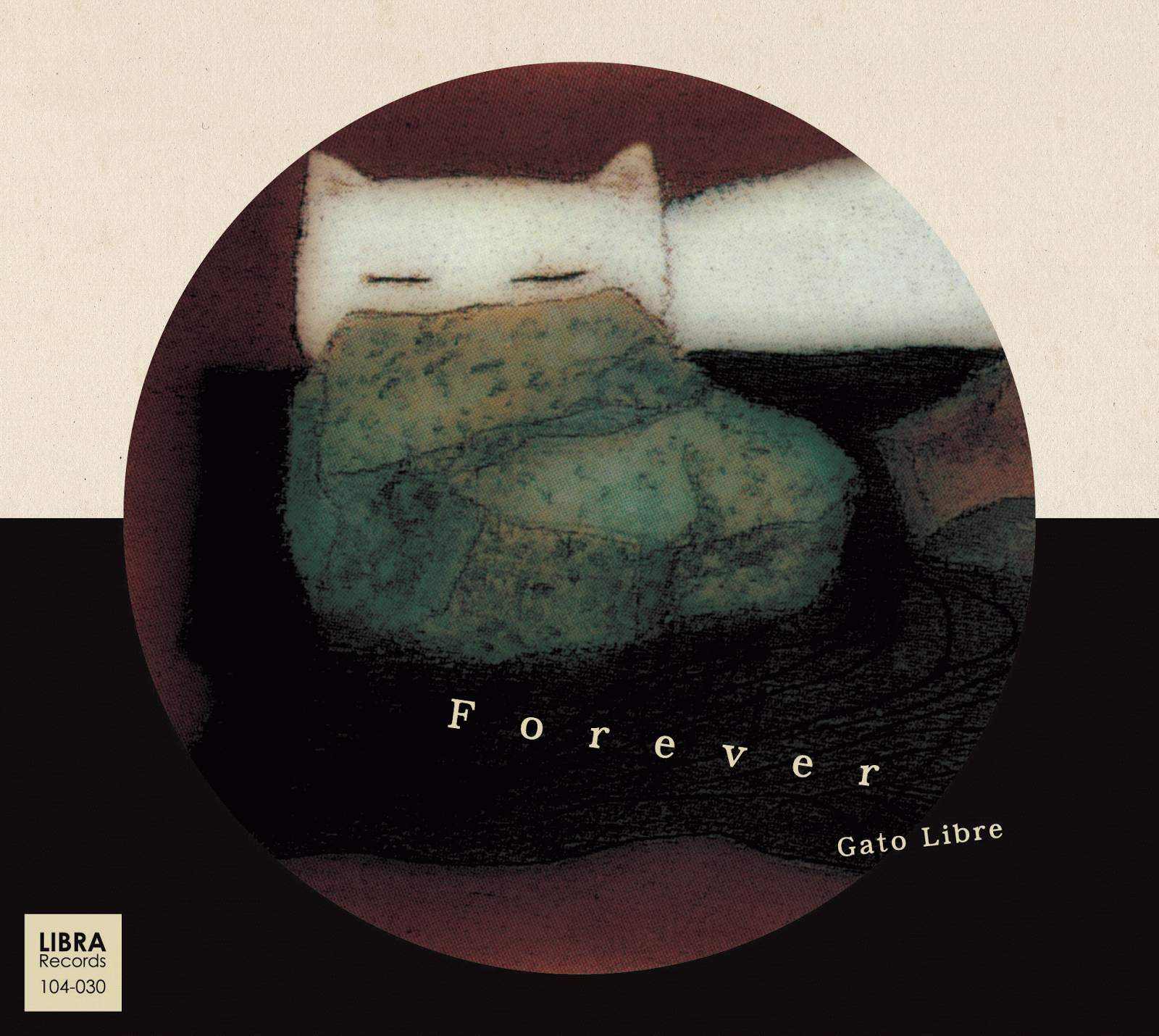
Gato Libre: Forever (Libra): Unless you reside in Japan, you're forgiven if the band's name doesn't immediately ring a bell. This is one of the multitude of projects that pianist Satoko Fujii is a part of, a quartet co-led with her husband, trumpeter Natsuki Tamura. Sadly, this album documents their final concert in their original lineup; bassist Norikatsu Koreyasu died just days after the performance. Even without that knowledge, there is a wistfulness that suffuses the music, accentuated by Tamura's Spanish-tinged playing. Fujii's spectral accordion work is a special delight here, as is Koreyasu's beautiful tone.

Vijay Iyer Trio: Accelerando (ACT): It's currently hip to knock journalists who give attention to Iyer (let alone give him an unprecedented number of DownBeat awards) rather than the dozen or so other youngish pianists who are incorporating multiple sonic elements and musical influences into their playing, but Accelerando is just too good to overlook. By now, it's a given that Iyer and his trio mates can dance cannily on variegated rhythmic streams. On Accelerando, they expand on the language, taking it to places that will have you returning again and again to hear their conversation.

Fred Ho and Quincy Saul: The Music of Cal Massey: A Tribute (Mutable Music): Cal Massey is not much known beyond his association with John Coltrane and other Philadelphia musicians, so plaudits to Fred Ho and Quincy Saul for showcasing his music, particularly the "Black Liberation Movement Suite" from 1969. Trombonist Frank Lacy is especially strong on the recording.

Henry Threadgill Zooid: Tomorrow Sunny/The Revelry, Spp (Pi): Still staunchly individualistic, Henry Threadgill sounds like no one else, and an opportunity to explore his innovative sound world is always welcome. Threadgill's music has assumed a slightly more austere manner than in the days of his Sextett, but it is no less compelling.

Nik Bärtsch’s Ronin: Live (ECM): A compilation of concerts by Swiss pianist Nik Bärtsch's band, this set rocks and grooves in inviting and mysterious ways. Like Threadgill's, Bärtsch's vision is firm enough that his music sounds immune from changes in personnel.

Dave Douglas Quintet: Be Still (Greenleaf): Dave Douglas' recordings are frequently conceptual, but none have been more personal than this dedication to his late mother. Using primarily hymns selected by his mother for her memorial service, Douglas adds the plainspoken voice of Aoife O'Donovan to create a distinctive blend of old and contemporary Americana.

Gonzalo Rubalcaba: XXI Century (5Passion): I have often found the Cuban pianist too rococo for my taste, but, here, his inclination to ornament every phrase pays dividends.  With Matt Brewer and Marcus Gilmore as a thoroughly modern rhythm section, Rubalcaba's piano weaves in and out of focus. In my four-star DownBeat review, I called this "smart, adventurous fun that works well on several levels."

Frank Kimbrough Trio: Live At Kitano (Palmetto): Best known for his quiet-but-sturdy work within the Maria Schneider Jazz Orchestra, Frank Kimbrough is an exceptional pianist with a rich imagination and a deep knowledge of jazz history that frequently colours his improvisations. But Kimbrough's not even the best thing here; that honour goes to drummer Matt Wilson, whose wit, ingenuity and daring are unparalleled.

John Abercrombie Quartet: Within A Song (ECM): Without apology, let me say that it's likely any recording guitarist John Abercrombie releases will find its way to my top 10 list, particularly when it includes drummer Joey Baron. While Abercrombie's recent albums have featured violinist Mark Feldman, here he teams with saxophonist Joe Lovano, and it's a toss-up who I prefer. The material—drawn mainly from iconic jazz artists of the '50s and '60s—is flawlessly executed. 

Bill Laswell: Means Of Deliverance: Solo (Innerrhythmic): Laswell's projects are usually teeming with sonic complexity, so who knew what to expect from his first solo bass recording. Beautiful and resonant, this is a recording that sounds both timeless and genre-free.

Thursday, December 13, 2012

Brubeck and Shankar: Genius Past 90

When an artist remains creative into his or her tenth decade there is a temptation to overstate the person's importance. Longevity has a way of clouding, or perhaps just softening, our critical view. In that regard, Eubie Blake and Doc Cheatham grew in stature with each passing year prior to their forestalled deaths. In essence, they seemed like stand-ins (on The Tonight Show with Johnny Carson and other high-profile venues) for one-time peers who actually had more of an impact, but had the misfortune of living shorter lives.

Ravi Shankar and Dave Brubeck—united in deaths just a week apart and several biographical details—were exceptions. They were vital, creative and influential until the very end.

If my memory serves, I heard Shankar sometime in the early '60s, courtesy of some of my parents' more adventurous friends. If it didn't really register for what it was at the time, that exposure laid the groundwork for easy acceptance of the sonic texture of the sitar when The Beatles incorporated it into their music a few years later.

I wrote last week of how Brubeck opened me to the concept of jazz as a place where the races could come together creatively. In that same way, the tonality of Shankar's music alerted me to the reality that there was a huge world beyond the western music I heard on a daily basis. What's more, Shankar's music was—prior to hearing Charlie Parker—my first exposure to other-worldly virtuosity. It helped me put rock guitarists in perspective. When my friends gushed over Eric Clapton, I pointed them to Shankar. Checking back on his appearance to open the Concert for Bangladesh, I was reminded of the frisson I felt in those days. As an example, dig the blazing exchanges between Ali Akbar Khan and Shankar at 4:36 and 4:51. If George Harrison took inspiration from Shankar's sound, surely guitarists like Duane Allman and Dickey Betts picked up an idea or two from riff trading like this.


Live exposure to Shankar was hard to come by where I grew up, but I took my mother—then, about 82—to see Shankar one night. We still talk about that concert as one of the times that our musical tastes met; a rare occasion.

In contemplating the death of these two giants so close together, I'm struck by a similarity that overshadows the fact that both men produced highly musical offspring. Both Brubeck and Shankar felt the sting of critics who labelled them as sell outs, thanks to their widespread popularity. In Shankar's case, it was more of a challenge, because it attacked him at the level of ethnicity and national pride. It happened early—an ego-shattering experience, he recalled—when he was performing with his brother's dance troupe in the mid-'30s, and then again, when The Beatles swept him up in their wake.

Both Brubeck and Shankar remained true to themselves and toughed out the criticism. They didn't buckle, and by overcoming their challengers they opened their music to much wider appreciation. Last week, Facebook was flooded with testimonials of how Brubeck opened musicians to new worlds beyond what was accepted in jazz, and those types of comments are now flowing for Shankar, too.

One other product of living 90-plus years is that people begin to take you for granted. Until you're gone. Only in retrospect, as we re-examine the careers of these giants, do we realize how much of the world as we know it was shaped by their contributions.


Wednesday, December 05, 2012

What Dave Brubeck Taught Me

Dave Brubeck was an enormous influence on my early jazz listening, and—along with his sidemen Gerry Mulligan and Paul Desmond—probably the only white jazz musician I listened to until Keith Jarrett and Chick Corea broke out on their own. If Brubeck was a jazz ambassador, taking American music to the Soviet Union and beyond, he was also an ambassador for a white kid in Canada, exploring. He looked like my dad. He was so square, he was hip.

I thought, okay, this music is universal; everyone can contribute. It was a big, open tent. That was an important thing to learn early on.

Skip forward 45 years or so, and I found myself working as the media relations resource for Ottawa's jazz festival one summer, with Mr. Brubeck slotted to headline our festival, accompanied by the entire National Arts Centre Orchestra before about 15,000 people on a spectacular summer evening. The concert was remarkable, but my best memory comes from earlier in the day.

Most headliners let their bandmates do the heavy lifting during soundcheck. The really big names sometimes don't show up at all. And if they are living legends in their late 80s?

I don't think we expected to see Dave Brubeck onstage that afternoon, yet there he was with his quartet, soundchecking as the hot summer sun beat down on the stage. We expected a rudimentary 15 minutes at most.

He started off wearing a jacket and white shirt, standard fare for anyone's elderly grandfather. But the soundcheck went on and on, his band working out nuances on pieces they must've played hundreds of times. The leader kept making adjustments, asking his guys to play things again.

The coat came off. The white shirt came off. There was Dave Brubeck, looking like a superannuated Bruce Springsteen in his undershirt, working his band hard through a full rehearsal. Smiling. Happy. Showing me that the joy of music is a gift you can keep forever.

So many lessons. So much memorable music.

Thursday, November 15, 2012

Behind The Curtain

Maybe it's human nature, but there's always a certain temptation to make things appear harder to do than they are, all in pursuit of the ultimate compliment: Wow! That's probably harder than it looks.

Sometimes, you just get lucky.

A case in point: recent family events put me somewhat behind schedule in completing an assignment for CBCMusic.ca on the development of Blue Note Records as one of the most recognized brands in popular culture. Two days before deadline, I had only one source lined up—former Blue Note artist Javon Jackson—and that was something of a 'gimme' since we're friends. I'd also promised my editor someone who could talk knowledgeably about what it takes to build and maintain a global brand and someone from inside Blue Note who could comment on how they manage the heritage that founders Alfred Lion and Francis Wolff developed between 1939 and the mid-'60s.

The first break was probably just timing: Blue Note president Don Was had an opening in his crazy schedule (you know, The Rolling Stones didn't need him in the studio that day, or something). Don was incredibly gracious and generous with his time, and gave me a great quote about how he manages Blue Note: "I just try not to make any shitty recordings."

It's tough to go wrong with a quote like that, and to make things even easier, Don repeated a story he had recounted to the New York Times about how he constantly refers to Lion's original mission statement for Blue Note.

The second break was more astounding. Here in Canada, advertising veteran Terry O'Reilly has become well known outside his industry with his extremely witty and insightful radio program Under The Influence. He's another busy guy, so I was very happy when he made himself available to respond to some email questions. Very nice, but what were the odds that he would know much about Blue Note Records? Turns out, he had not only done a lot of thinking about Blue Note and its brand, but he actually worked with legendary Blue Note designer Reid Miles back in the '80s. He had a ton of interesting things to say.

When you get good stuff like that, an article almost writes itself. You just have to make it look hard.

Check out the article here.

Monday, November 05, 2012

An Ode To A Man With Huge Ears

My father died two weeks ago at the age of 90.

He had a good life—charmed, actually, in many ways—and he was lucky to slide away from us without much suffering.

He left me with many, many things, as a good man who fathers you for 58 years will do, and the best of all things was his curiosity about music.

Here's what a typical Sunday morning sounded like at my house in the 1960s: I'd be awakened by the music of Glenn Miller, Duke Ellington, Benny Goodman, The Kingston Trio, Elvis Presley, or some faceless Hawaiian music. My father bought one of those massive, coffin-like stereo systems in about 1961, but he was smart enough to go with a Grundig system with really decent sound. That system, and the record club phenomenon of the time, led to him consuming an endless amount of LPs. My brothers were off to college, and they had left behind LPs by Gene Vincent, Elvis, Santo & Johnny, and all those groups that came along during the folk music explosion.

My dad didn't discriminate; he'd roll straight from GI Blues to a stereo demonstration record featuring Bob & Ray, to Goodman featuring Charlie Christian, to the soundtrack from South Pacific. Sundays streamed by, usually ending only when golf came on TV late in the afternoon.

One album my father had changed my life. It was called Two Of A Mind—a 1962 session featuring Gerry Mulligan and Paul Desmond. As noted, he listened to a lot of big band music, or by Goodman's small sub-groups, but the Mulligan/Desmond LP was the first thing I heard him play that captured a contemporary sound. It was also one of the few records he played that I went back and checked out myself. From there, it wasn't a big step to a Charlie Parker collection that a sax-playing friend of mine brought over one day after school. The rest, as they say, is history.

Perhaps the best thing about the way my father exposed me to music were the stories he told me about the musicians. He loved to tell stories, and the music provided a great backdrop to his tales of Frank Sinatra's early years, or Goodman's efforts to convince his parents that a jazz career was a worthy goal. He might've scoffed at Elvis' hair, but he never put down his music.

In effect, he taught me what I needed to know when I landed a job hosting a show on a campus FM station in the late 1970s.

My father with his latter-day turntable
Let's not gloss things over; he disagreed with a lot of the things I listened to when I was in my teens. He told me to turn down The Allman Brothers Band more than once, and said that Muddy Waters sounded like he had a headache, and was giving him one, too. He once asked me what I thought hours of listening to music was going to do for me, but he balanced that years later by showing real pride in the career I built for myself as a music journalist.

One of the best things about my father's long life was that I had a chance to share a lot of music with him when I was an adult. I particularly recall taking him to see his hero, Goodman, at one of the clarinetist's later concerts. I don't think I can remember my father having as good a time outside of family gatherings. Very recently, when he was really in failing health, he was still interested and alert enough to enjoy some first-hand stories about Goodman I learned from one of his sidemen.

I wish I could say that I've been as influential on my own two daughters' musical education. Sadly, that's one of the things that fathers have lost control of, thanks to the advent of cheap personal listening devices. Back in the 1960s, you could do a lot worse than waking to Ellington, and having the stereo controlled by someone with as much curiosity and wisdom as my father.

In Ottawa's Hintonburg, Worlds Collide and Stomachs Win Over Ears

Aside from jazz, one of my favourite interests is cities and how they develop, and no city attracts my interest more than my own.

I grew up just to the west of a working-class neighbourhood in Ottawa, which was known variously as Mechanicsville and Hintonburg. In recent years, the area has been undergoing sweeping change, with small, contemporary restaurants replacing decades-old KFC outlets and independent greasy spoons. Consequently, the area has attracted a growing number of young families, artists and technology workers, who have taken over the densely packed houses that straddle the main artery. For those of us who grew up in the years when the neighbourhood was anything but a destination, the change has been heady.

One of the cornerstones of the neighbourhood's change has been the Elmdale House Tavern, one of the last of the city's traditional beer parlours (which, as recently as the 1970s, featured 'Men's' and 'Ladies and Escorts' entrances and strictly segregated service policies). A few years ago, a couple of neighbourhood veterans bought the 80-year-old business, replaced the heating/cooling system and other infrastructural elements, and launched a six-night-a-week live music policy—the first of its kind in Ottawa in many years. While the booking policy only occasionally extended to include jazz artists like Charlie Hunter, the musical menu was eclectic, and the opportunities for young bands legion.

Meanwhile, across town, in another once-dodgy neighbourhood, another dedicated, young entrepreneur was shaking things up with a funky restaurant that offered sustainably sourced seafood and employed some of the city's most creative chefs. But, while the Elmdale House maintained the down-and-dirty essence of its roots, and kept prices low to build its audience, the Whalesbone Oyster House offered main courses that scrape the $50 mark and attracted high-flying Cabinet ministers from Canada's federal government.

Now, Ottawa's music and food scenes are abuzz with news that Whalesbone owner Joshua Bishop has purchased the rights to the Elmdale House business and announced plans to reduce the live music by 60 percent, cut the seating capacity from 160 to 95, and add a kitchen to the old structure.

Worlds collide and sparks fly. Foodies and music fans are choosing sides and flinging tweets that knock opposing views.

I'm a fan of Whalesbone and its sustainable fish, but I'm mourning the loss of this important music venue. Ottawa has always had a problem with sustaining a full-time music scene—being sandwiched  between the much-larger scenes in Montreal to the east and Toronto to the west—and the Elmdale House was going a long way toward turning that around.

In this case, it's clear that the foodies have won out and musicians and their fans are on the losing end.


Friday, October 19, 2012

David S. Ware 1949-2012

Photo by Michael Jackson
Wasn't that a man?

David S. Ware made a mighty sound, and was one of those musicians whose soulfulness was evident in every note he played.

At times, he seemed to be indomitable. I saw him once at the Victoriaville festival just after the taxi cab he drove had been broadsided in an accident. Ware was on crutches, and in obvious pain, but he put everything he had into his playing. He always did.

The fact that he seemed to rebound from a kidney transplant was no surprise, but in the end he couldn't beat the disease.

There is a big outpouring of love for Ware around social media today, and I believe a large part of the connection people felt to him was the fact that he was a bridge to the giants (John Coltrane and Albert Ayler) that many of us didn't get to see in their prime. Ware was a worthy heir to their no-holds-barred sonic attack, and he attracted a large number of young fans who grew up listening to various genres of electric rock music. He welcomed them all, and introduced them to young musicians like Matthew Shipp and Susie Ibarra, helping to propel their careers into a broader realm.

David S. Ware: Big spirit. You will be missed.